Winter — History & Facts
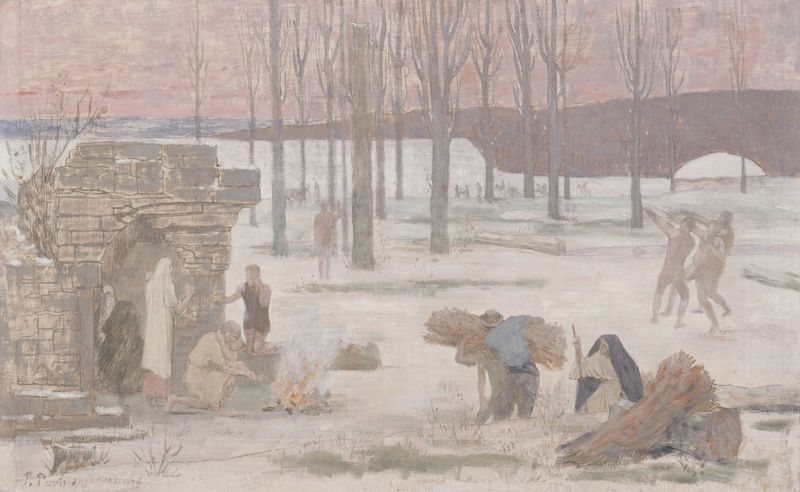
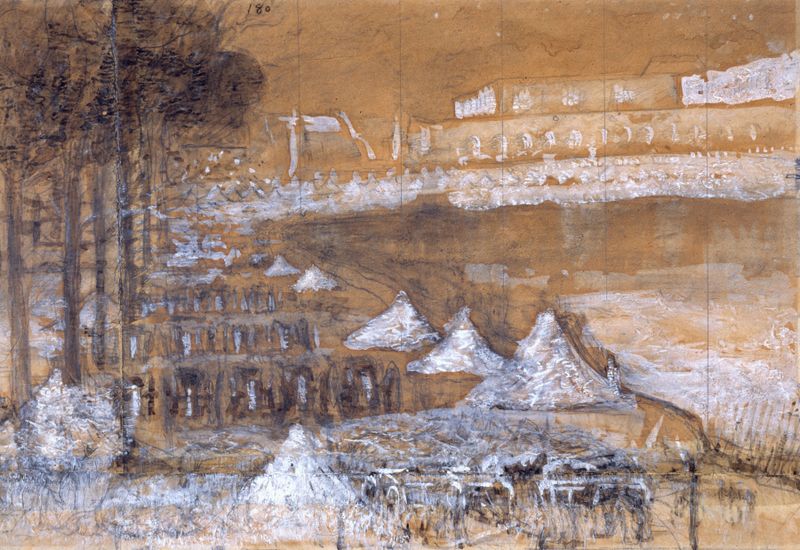
In Winter, stillness cloaks the landscape, yet beneath its tranquil surface lies an unsettling tension, hinting at a violence just below the serene façade. The cold grips the scene, imbuing it with a starkness that invites contemplation while hinting at the harshness of nature. Look to the left where frost-laden trees arch their branches, their skeletal forms silhouetted against a muted sky. The palette of icy blues and grays captures the essence of winter — a chilling reminder of fragility.
Notice how the delicate brushstrokes create a sense of movement in the falling snowflakes, which contrast sharply with the heavy stillness of the earth below. This interplay of light and shadow reveals an unspoken struggle, as if the landscape grapples with its own survival in the face of a frigid existence. As you explore the painting further, the contrasts deepen. The vibrant patches of white snow contrast with the earth's dark tones, embodying a complexity of life and death, hope and despair.
The overall composition draws the eye to an unseen horizon, fostering a sense of longing and contemplation, suggesting that even in desolation, there is a story waiting to unfold — a reminder of nature's unpredictable violence and beauty. Completed in 1889, this artwork emerged during a period of reflection for the artist, who had found acclaim in France yet was grappling with the changes in the art world. The transition towards modernism loomed large, as traditional methods clashed with evolving forms of expression. In this context, Winter stands as a testament to the enduring exploration of human emotions within the confines of a natural world that is at once beautiful and cruel.