
Wooden house — History & Facts
The allure of a simple wooden house often masks the stories of hardship and longing hidden beneath its surface. In this piece, the artist invites us to explore the juxtaposition of façade and essence, revealing how beauty can be both a refuge and a reminder of life’s complexities. Look to the left at the delicate strokes that form the weathered wooden beams, each line rich with texture and history. Notice how the muted yet warm palette of ochres and browns envelops the structure, creating an inviting aura while simultaneously hinting at decay.
The slant of light filtering through the trees casts gentle shadows that dance around the house, enhancing the feeling of nostalgia and evoking a sense of time standing still. The composition draws viewers in, inviting them to ponder the life that pulses within its walls. As you examine the details, consider the contrasts embedded within the artwork—the stark lines of the house against the softness of the surrounding foliage. Here lies an emotional tension: the steadfastness of the wooden structure juxtaposed with the fragility of nature.
The crumbling corners speak to the passage of time, and the light illuminating the house evokes memories of warmth, while the shadows whisper of stories left untold. Each element combines to evoke a bittersweet longing for what once was. In 1897, the artist was deeply influenced by the dynamics of the emerging art scene in Poland, where nationalism and identity were central themes. Living in a time when traditional forms were being challenged, she sought to capture the essence of her surroundings, blending realism with an emotional depth that resonated with contemporary sensibilities.
Wooden house stands as a testament to her ability to reflect the beauty and pain of everyday life through a unique artistic lens.
More Artworks by Maria Klass-Kazanowska
Browse all →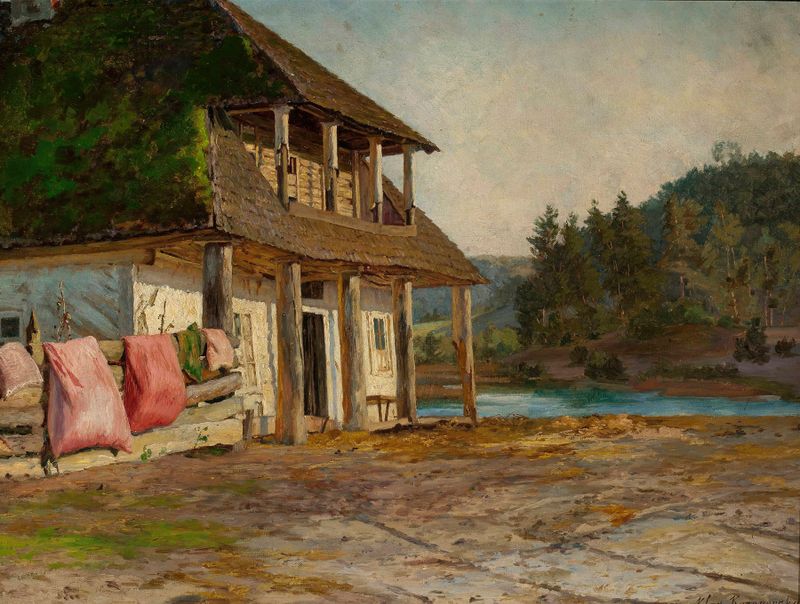



More Architecture Art
Browse all →
The statue of Liberty
Frédéric Auguste Bartholdi

View of Houses in Delft, Known as ‘The Little Street’
Johannes Vermeer

View of Houses in Delft, Known as ‘The Little Street’
Johannes Vermeer

The Cathedral in Rouen. The portal, Grey Weather
Claude Monet

The yellow house
Vincent van Gogh

The Church in Auvers-sur-Oise, View from the Chevet
Vincent van Gogh