
The Third of May 1808: Goya's Stark Depiction of War's Horror
The Third of May 1808 by Francisco de Goya is a profound depiction of human suffering during wartime. This artwork, housed at the Museo del Prado, captures the raw emotion and chaos of a historical event with striking intensity. As a piece of Romanticism, it reveals Goya's mastery in conveying the horrors of conflict through art. Explore the story behind this painting and its impact on art history.
The Story Behind the Work
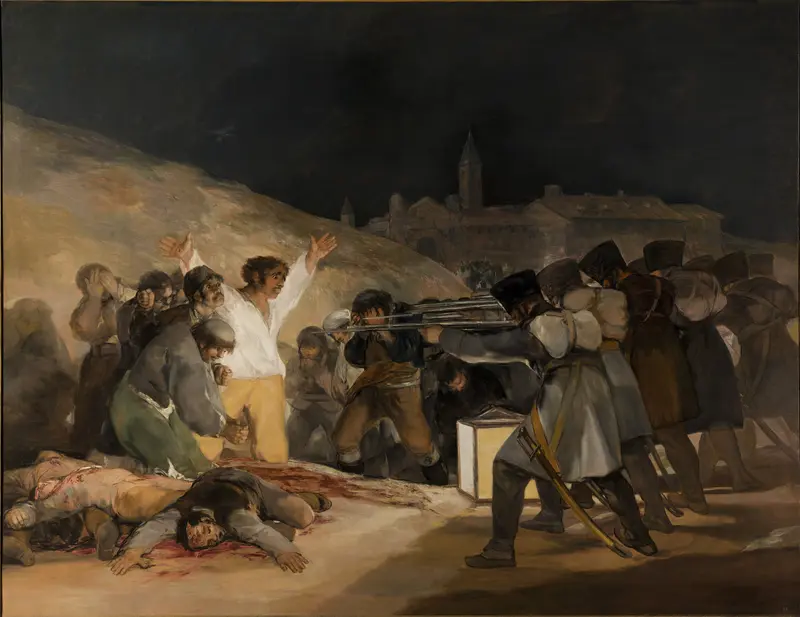
Francisco de Goya's The Third of May 1808 was painted in response to the brutal events that took place in Madrid during the Peninsular War. On May 2nd, 1808, Spanish citizens rose against the occupying French forces, leading to a violent retaliation. Goya's painting, completed in 1814, captures the aftermath of this uprising, focusing on the execution of Spanish patriots by a French firing squad. This historical moment is immortalized on canvas, highlighting the tragic consequences of war.
What You See
The composition of The Third of May 1808 is both dramatic and moving. At the center, a man in white stands with arms outstretched, a gesture that speaks of both desperation and defiance. The stark contrast between the illuminated figure and the dark silhouettes of the firing squad to the left creates a powerful visual impact. Goya's use of a muted palette of ochres and blacks adds to the haunting atmosphere, while the rough brushwork conveys a sense of urgency and chaos.
Meaning and Interpretation
Goya's painting serves as a powerful anti-war statement, highlighting the brutality and inhumanity of conflict. The central figure, with his expression of fear and defiance, symbolizes the resilience of the human spirit in the face of oppression. The anonymity of the soldiers, depicted as faceless figures, emphasizes the mechanized nature of war and the loss of individuality. This work is not only a historical record but also a universal commentary on the horrors of war.
Historical Context
Created during the Romanticism movement, The Third of May 1808 reflects the era's focus on emotion and individual experience. The painting's historical context is rooted in the Peninsular War, a conflict that saw Spain fighting against Napoleon's forces. Goya, who witnessed the devastation firsthand, was profoundly affected by the events, which is evident in his unflinching portrayal of the tragedy. This artwork remains a critical piece in understanding the impact of war on society and art.
Where to See It Today
The Third of May 1808 is part of the collection at the Museo del Prado in Madrid, Spain. This renowned museum houses an extensive collection of works by Francisco de Goya, providing visitors with a comprehensive view of his artistic evolution and contributions to Romanticism. The painting remains a highlight of the museum's historical collection.
Related Works by Goya
Goya's exploration of war's impact is further evident in his series Los desastres de la guerra. This series of etchings looks into the grim realities of the Peninsular War, capturing the suffering and chaos experienced by civilians. Another notable work, El sueño de la razón produce monstruos, reflects Goya's critique of societal issues, using allegory to depict the consequences of abandoning reason.
Francisco de Goya's The Third of May 1808 remains a potent reminder of war's brutality and the enduring human spirit. This and other works by Goya are available for free high-resolution download on FineArtFree, allowing you to explore these historical major works in detail.