
A Classical Temple — History & Facts
Can paint confess what words never could? In A Classical Temple, the canvas becomes a portal to a world of transformation, revealing the delicate interplay between nature and architecture, humanity and the divine. Focus on the majestic temple that dominates the center — its grand columns rise with stoic grace against a backdrop of lush greenery. The interplay of light and shadow creates a dynamic contrast, guiding your eyes along the intricately carved stonework and the soft reflections of sunlight filtering through the leaves. Notice how the warm tones of the temple's façade contrast with the cooler greens and blues of the surrounding landscape, inviting you to explore the harmony between structured beauty and organic life. Within this serene setting, there is a tension between permanence and transience.
The temple, a symbol of human aspiration, stands resilient against the passage of time, while the vibrant foliage around it suggests the inevitable cycles of nature. The path leading toward the temple hints at a journey, one that invites contemplation of mankind's quest for knowledge and lasting beauty amid a shifting world. Created around 1780, this work by Louis Gustave Taraval emerges during a period of artistic exploration in France, as Neoclassicism was on the rise, driven by a desire to return to the ideals of ancient Rome and Greece. Taraval, working in the shadow of the Enlightenment, sought to elevate the classical form while capturing the beauty of nature, reflecting both personal and societal transformations during a time of profound change.
More Artworks by Louis Gustave Taraval
Browse all →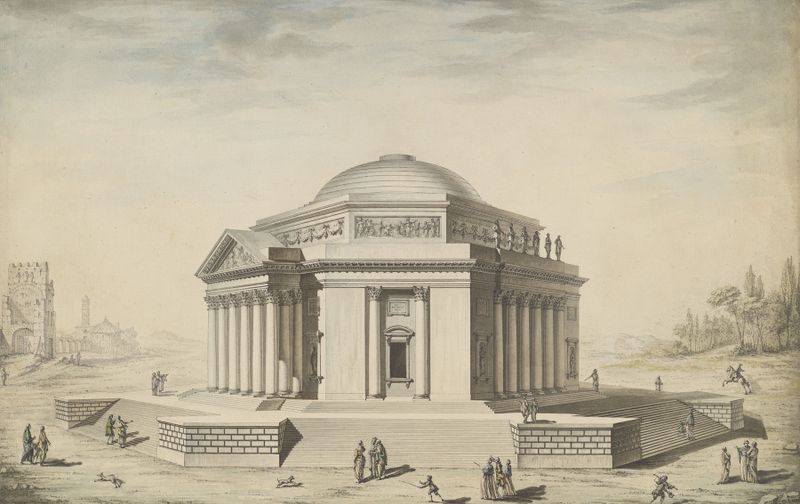
More Architecture Art
Browse all →
The statue of Liberty
Frédéric Auguste Bartholdi

View of Houses in Delft, Known as ‘The Little Street’
Johannes Vermeer

View of Houses in Delft, Known as ‘The Little Street’
Johannes Vermeer

The Cathedral in Rouen. The portal, Grey Weather
Claude Monet

The yellow house
Vincent van Gogh

The Church in Auvers-sur-Oise, View from the Chevet
Vincent van Gogh