
A Mountain Landscape — History & Facts
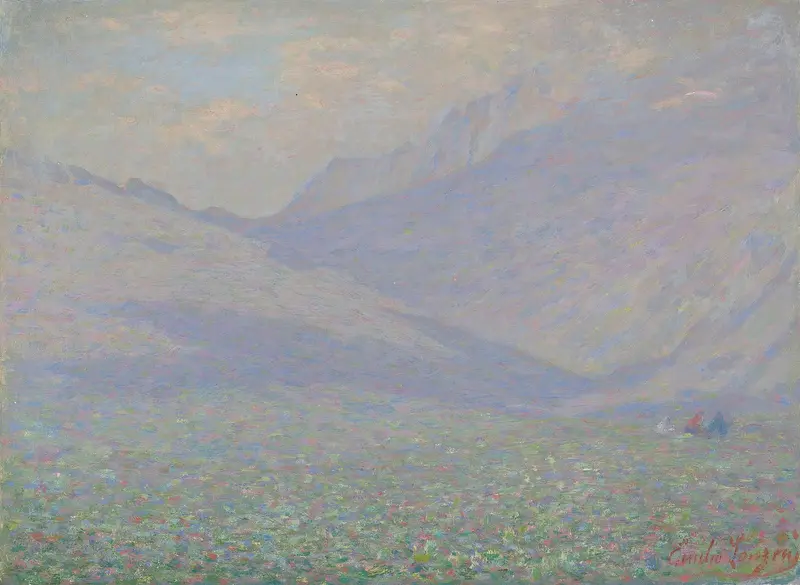
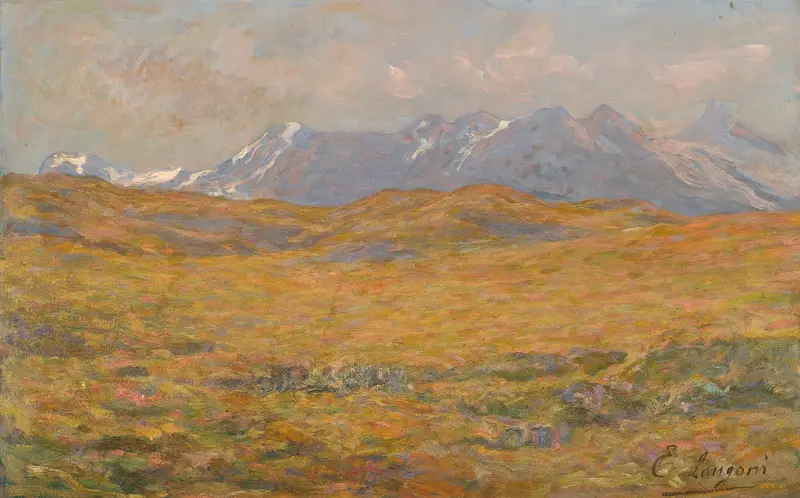
What secret hides in the quiet of the canvas? In A Mountain Landscape, the solitude of the mountains invites contemplation, embodying a profound sense of divinity and tranquility. Focus on the horizon, where the peaks rise majestically against a soft, ethereal sky. The artist's brushstrokes evoke a delicate interplay of light and shadow, casting a serene ambiance over the hills. Notice how the muted, earthy tones of green and brown ground the composition, while the subtle blues and whites of the clouds create a dreamy contrast, guiding your eyes upward.
This gentle ascent from the earth to the heavens encapsulates a harmonious blend of nature’s majesty. Hidden within the serene beauty are layers of meaning. The starkness of the mountains symbolizes both isolation and strength, reflecting a duality of human experience. The tranquil foreground, with its lush greenery, suggests a sacred space—a refuge for reflection.
Each element, from the winding path to the looming peaks, encapsulates a journey, inviting the viewer to explore themes of divinity, solitude, and introspection. Created around 1904-05, this work emerged during a period of great change in Longoni's artistic journey. Having moved towards a more introspective and symbolic style, he sought to capture the sublime beauty of nature in ways that connected viewers to deeper emotional and spiritual experiences. Amidst a shifting art world that increasingly embraced modernism, A Mountain Landscape stands as a testament to the enduring power of natural beauty and reflection.
More Artworks by Emilio Longoni

More Landscape Art

The Starry Night
Vincent van Gogh

View of Delft
Johannes Vermeer

Water Lilies
Claude Monet

The Grand Canal, Venice, looking north-west from the Ca' Corner to the Ca' Contarini degli Scrigni, with the campanile of Santa Maria della Carità
Canaletto

Windsor Castle
Canaletto

The Grand Canal looking North-East from the Palazzo Dolfin-Manin to the Rialto Bridge
Canaletto