Abend — History & Facts
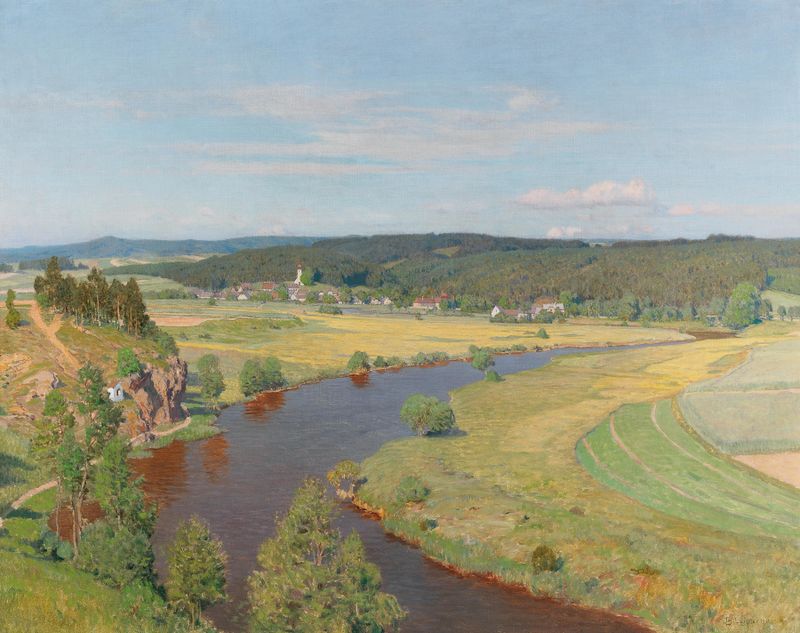
Can beauty exist without sorrow? In the ethereal world captured by Abend, one can feel the delicate threads of dreams intertwining with the shadows of unspoken grief. Look to the center of the canvas, where soft hues of lavender and deep blue meet, creating a twilight sky that seems to breathe. The gentle gradient draws the eye upward, evoking a sense of transcendence, while the wispy clouds float, hinting at fleeting moments—a reminder that time is ever shifting. The horizontal lines of the horizon ground the piece, while subtle textures invite you to explore the depths of each color, revealing layers of emotion embedded in the strokes. As you gaze longer, notice the interplay of light and darkness, representing the duality of existence.
The warmth of the fading sun contrasts with the encroaching night, embodying the tension between hope and melancholy. This ambiguity forms a poignant reflection on the nature of dreams; they are often beautiful yet tinged with the knowledge of what is lost. Every brushstroke becomes a whisper, suggesting unfulfilled desires and the fragility of happiness, leaving the viewer suspended in a moment of quiet introspection. During an undetermined period of his artistic journey, Thomas Leitner created Abend, a work that resonates with personal and universal themes.
At that time, he was exploring the boundaries of perception and emotion, influenced by contemporary movements that sought to push beyond traditional confines. The world was in flux, with artists questioning the very essence of reality, and Leitner's work emerged as a testament to both the beauty and sorrow that coexist within our dreams.