Abendlandschaft — History & Facts
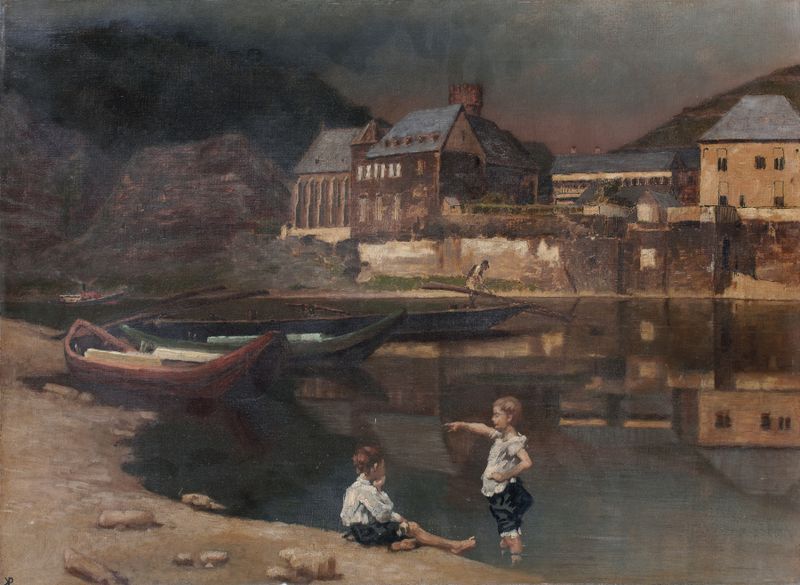
Could a single brushstroke hold eternity? In the frayed fabric of existence, chaos unfurls itself with every stroke of the brush, breathing life into the stillness of the canvas. Look to the top left; the swirling clouds seem to dance in the twilight, their tumultuous forms capturing the fleeting essence of day yielding to night. The artist's use of deep blues and purples conveys a sense of impending mystery, while streaks of warm orange suggest remnants of sunlight hanging delicately in the air. As your gaze traverses the canvas, notice how the turbulent sky contrasts with the tranquil landscape below, where muted greens and browns create a grounded, yet uneasy serenity. The interplay of chaos and calm in this piece speaks to the duality of human experience.
Each brushstroke becomes a metaphor for life's unpredictability, capturing moments of beauty amid disorder. The horizon line, though seemingly stable, is alive with movement—waves of grass and faint shadows hint at an unseen world, teetering on the brink of revelation. The tension lies in this balance, as if the landscape itself is a witness to the unresolved narratives of life. Created in a time when the boundaries of artistic expression were rapidly expanding, the artist found inspiration to explore themes of nature and emotion in Abendlandschaft.
Set against the backdrop of late 19th-century Europe, a period marked by both innovation and upheaval, this work reflects a personal journey toward understanding the embrace of chaos within the serene. It stands as a testament to an era that sought to capture the essence of life in all its tumultuous complexity.