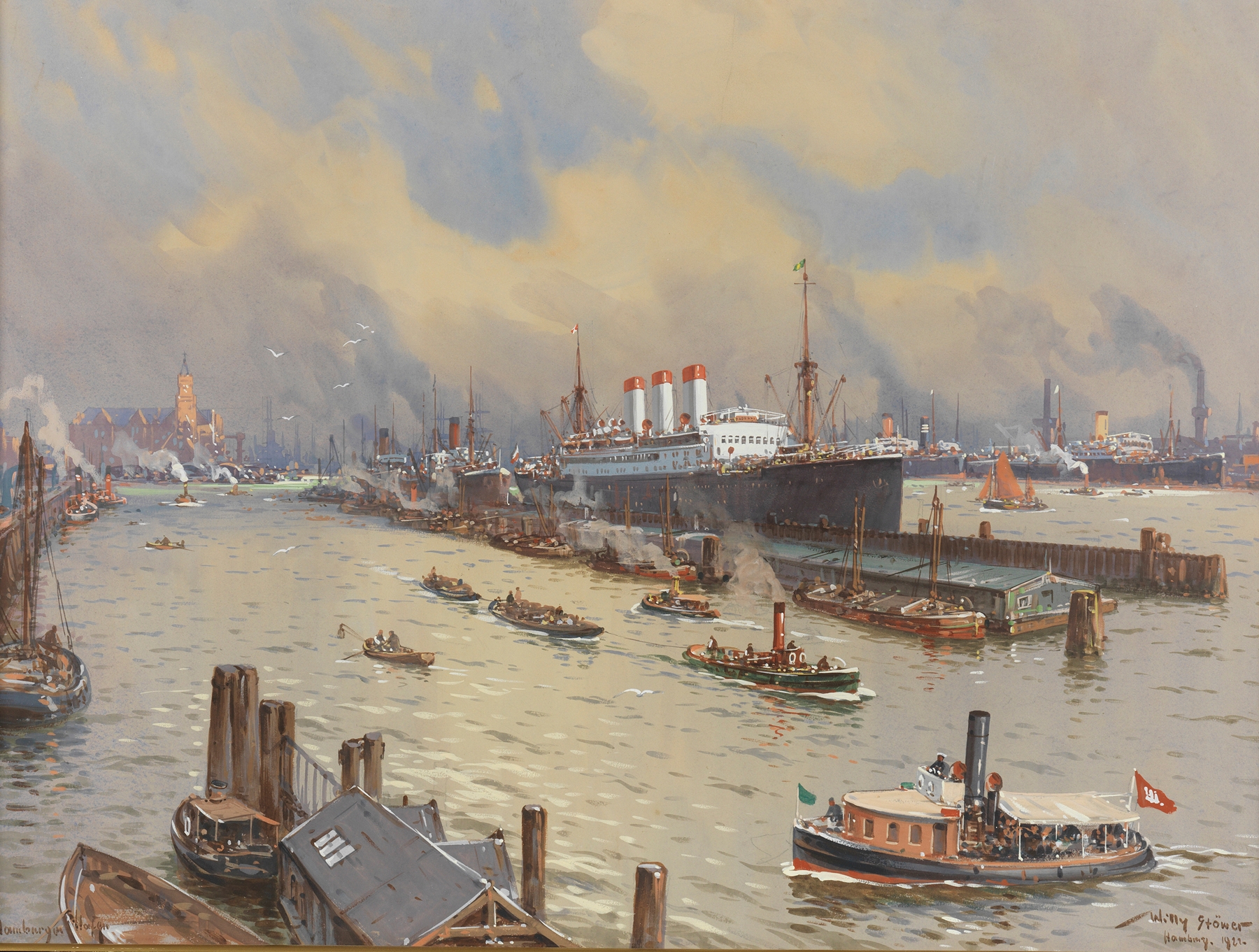
Abreise von S.M. des Kaisers von Vigo. 16. März 1904 — History & Analysis
What if silence could speak through light? In Abreise von S.M. des Kaisers von Vigo. 16. März 1904, the artist captures a moment fraught with the weight of time and the inevitability of decay, presenting a world that reflects both departure and loss.
Look to the foreground, where the ship, a majestic vessel poised for departure, is cast in hues of blue and gray, evoking a sense of urgency and melancholy. Notice how the brilliant light breaks through the clouds, illuminating the vessel’s elaborate details while casting elongated shadows that hint at what is being left behind. The composition is carefully structured; the horizon line draws the eye toward the distant sea, creating an infinite sense of space that contrasts the confined, intimate nature of the ship and its crew. Beneath the surface, layers of meaning unfold. The light, a symbol of hope and possibility, is paradoxically intertwined with the darkening shadows, suggesting the duality of progress and loss.
The ship's looming presence can be seen as a metaphor for the passage of time where every departure signifies not just a journey forward, but an acknowledgment of what is surrendered. In the background, faint figures stand as specters, embodying the silence of those left behind, representing the silent weight of nostalgia. Painted during a turbulent time in the early 20th century, when Germany was asserting its imperial ambitions, the work reflects Willy Stöwer's engagement with maritime themes, prevalent in a period marked by significant technological advancements and the feelings of grandeur associated with naval power. This painting stands as a poignant reminder of the delicate balance between ambition and the haunting memory of decay.