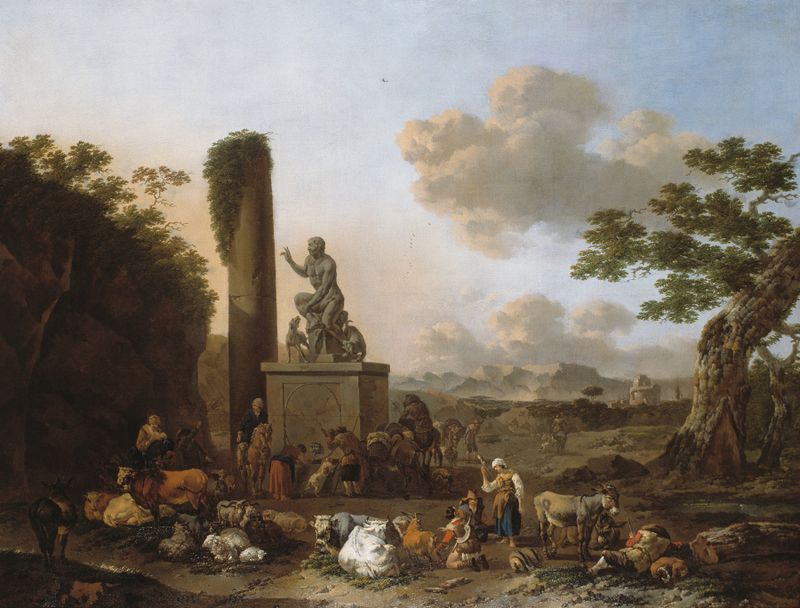
An Italianate wooded landscape with a woman riding an ox and a drover beside with his animals — History & Facts
Can paint confess what words never could? In the hands of Nicolaes Berchem, chaos transforms into tranquility, inviting viewers to explore the delicate interplay between the wild and the tame. Look to the center of the canvas where a woman confidently rides an ox, her posture steady against the backdrop of lush woods. Notice how the dappled sunlight filters through the leaves, casting intricate patterns on the ground below. The drover walks beside her, his animals grazing peacefully, contrasting the movement of the woman and her beast.
Berchem's masterful brushwork captures the textures of the foliage and the ox's coarse fur, while a harmonious palette of greens and earthy browns unifies the scene. Beneath the surface, there lies a tension between chaos and harmony. The juxtaposition of the ox and the wandering animals hints at the unpredictability of nature, while the serene figure of the woman suggests a symbiotic relationship with the wilderness. Elements of light and shadow play across the scene, evoking a sense of fleeting moments in the landscape—a reminder that chaos can exist alongside the stillness of daily life.
Each detail, from the drover's contemplative gaze to the woman’s poised demeanor, enriches the narrative, inviting deeper reflection on balance and coexistence. During the 17th century, when this piece was likely painted, Berchem found himself amidst the flourishing Dutch Golden Age. The artist was known for his idyllic landscapes that often combined realistic elements with imaginative scenes. At this time, art was an exploration of leisure and the pastoral ideal, reflecting both the changing relationship humans had with nature and the emerging appreciation for rural life, which Berchem captured beautifully in his work.