Ankunft der Postkutsche — History & Facts
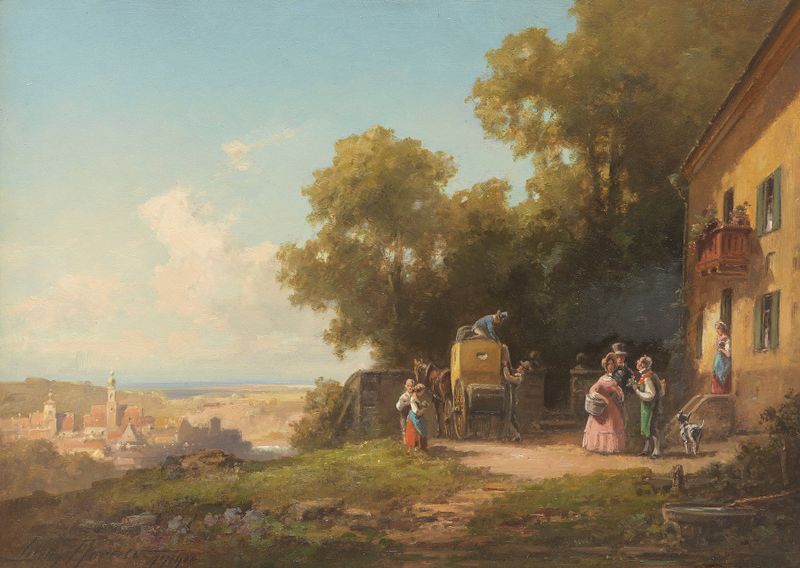
In every stroke lies a testament to faith, urging us to see beyond the visible world. Look towards the center of the canvas, where the postcoach bursts forth, a vivid amalgamation of warm ochres and deep blues. The horses, muscles rippling, seem to gallop through time, accompanied by a flurry of dust that dances around their hooves. Notice how the sunlight breaks through the clouds overhead, illuminating the scene with a golden hue, evoking a sense of hope amidst the chaos of travel.
Each figure is meticulously rendered, their expressions a blend of anticipation and weariness. As you delve deeper, the emotional tension of the piece comes alive in the juxtaposition of movement and stillness. The urgency of the postcoach contrasts sharply with the stationary figures who await its arrival, embodying the duality of journey and destination. Here lies an unspoken narrative of trust; the travelers hold onto faith, not just in the arrival of the coach, but in the promise of reunion and change that it signifies.
The subtle detailing of the landscape amplifies this sense of longing, with the distant hills symbolizing obstacles to overcome. Willy Moralt painted this piece during a period marked by a fascination with realism in the early 20th century. While the exact date remains uncertain, it reflects an era where artists sought to depict everyday life with authenticity. Moralt’s work emerged against the backdrop of a rapidly modernizing world, capturing the essence of a moment that resonates with the universal human experience of hope and expectation.