At the beach, Ostend — History & Facts
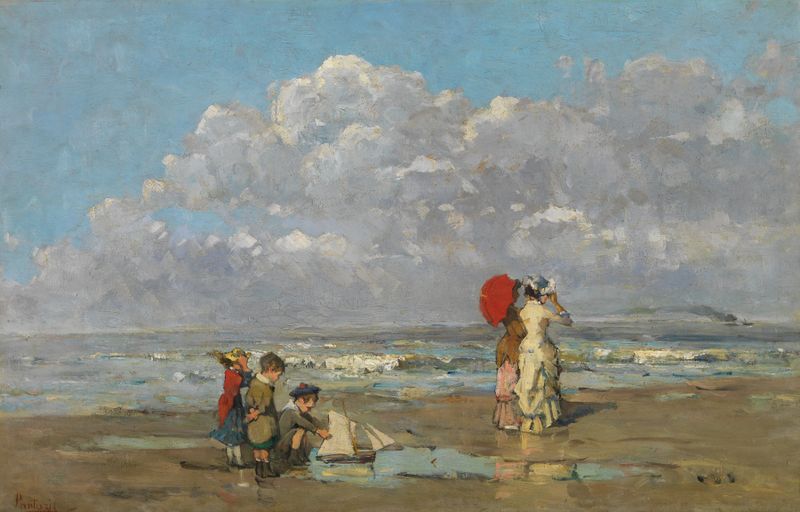
Who listens when art speaks of silence? In the stillness of this moment, the viewer is beckoned to a dreamlike realm, where the gentle lull of the waves melts into an expanse of soft hues and serene forms. Look to the center, where the glistening shoreline meets the horizon, a delicate blend of blues and golds. Notice how Pantazis employs fluid brushstrokes to create a seamless transition between sea and sky, inviting your gaze to wander endlessly. The figures—stretched out on the sand like whispers of contentment—seem both anchored in reality and drifting in reverie.
The muted palette evokes a sense of calm, while shadows dance lightly, hinting at the warmth of a sun lingering low. Dig deeper, and you may find hints of longing interwoven within the tranquility. The solitary figure, perhaps deep in contemplation, contrasts with the playful waves, embodying the tension between presence and absence, connection and solitude. This juxtaposition encourages a reflection on what one seeks in moments of stillness—an escape from the world or a deeper understanding of oneself. Painted in the late 19th century, during his time in France, Pantazis was influenced by the Impressionist movement, which emphasized capturing fleeting moments with vivid color and light.
The work reflects a blend of his Greek heritage and the rich artistic environment in which he found himself. His personal journey, marked by exploration and introspection, resonates through the canvas, inviting us to contemplate our own dreams amidst the silence.