Autoportrait de Jean-Alexandre-Joseph Falguière — History & Facts
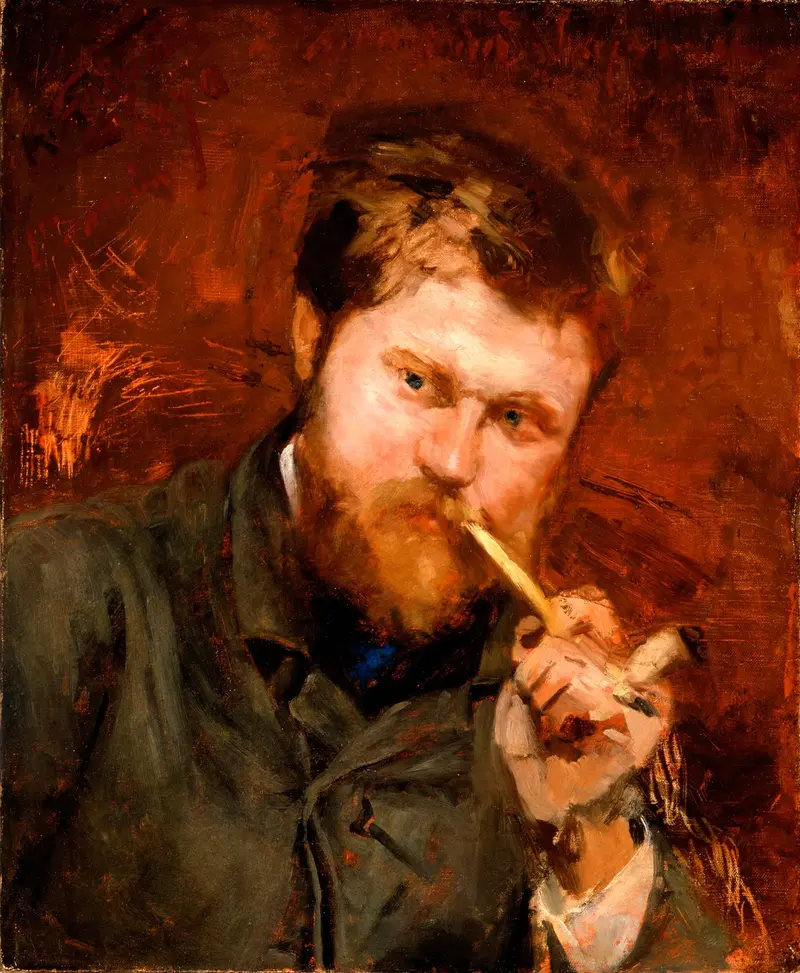
A single, unflinching gaze commands the viewer’s attention, as if the artist has caught himself in a moment of self-scrutiny. The brushwork is rough and direct, leaving the surface alive with texture, while the palette is pared down to earthy ochres and browns. Light falls across the face, carving out the cheekbone and the furrowed brow, while the background dissolves into shadow, forcing all focus onto the eyes—wide, alert, and questioning.
This is not a flattering self-portrait, but one that seems to wrestle with the act of seeing and being seen, the artist’s head turning sharply as if interrupted in the midst of thought. The unfinished quality of the collar and jacket draws attention to the urgency of the moment, as if the painter cared only for the truth of the face. Works like this emerged in the late nineteenth century, when artists increasingly turned the mirror on themselves, not for vanity but as a way to probe identity and artistic purpose. Self-portraiture became a kind of laboratory for experimentation, with painters using their own features to test new techniques and psychological depths.
Alexandre Falguière was better known as a sculptor, but here, in this painting photographed in 2017 and preserved as an “own work,” we glimpse the restless energy of a period when boundaries between disciplines and genres were dissolving. History has kept few traces of such intimate studies, but their rawness speaks directly to anyone who stands before them—inviting us to look again, and to wonder what the artist saw in himself.