Battle near a port — History & Facts
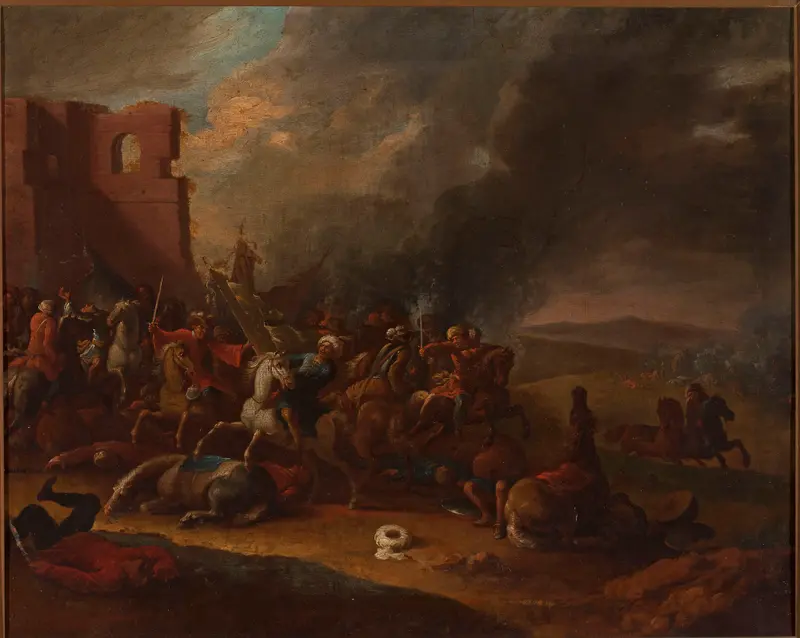
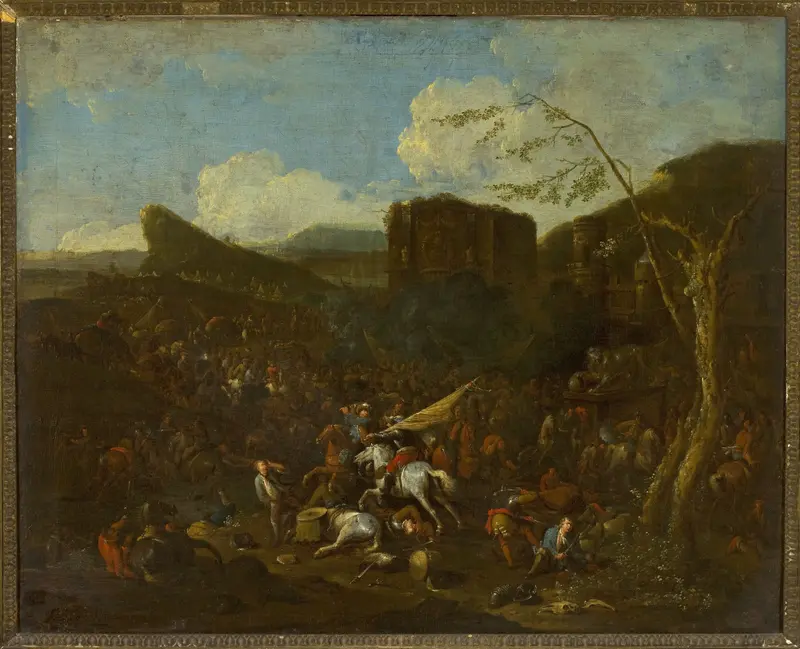
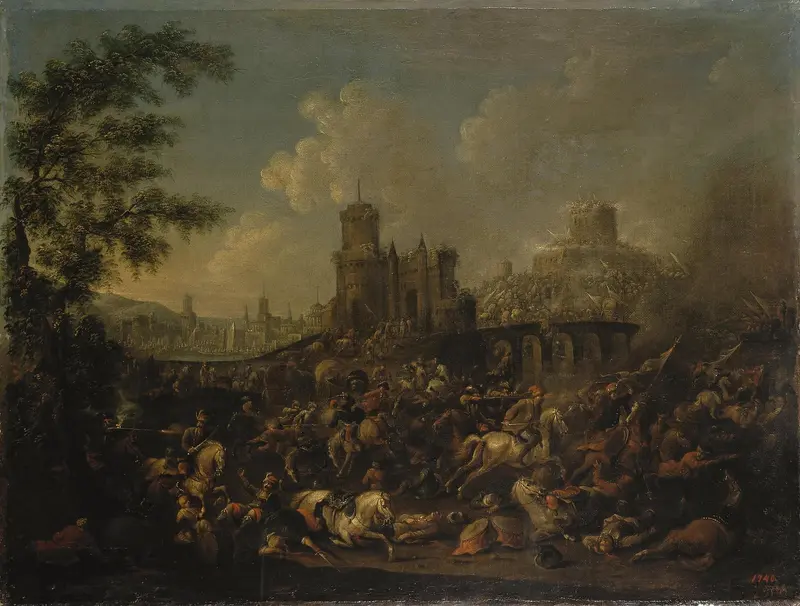
A tangle of bodies and banners sprawls beneath a restless sky, drawing the viewer into the chaos of a battlefield that feels both immediate and distant. The painter, Arnold Frans Rubens, sets the drama not at the heart of the clash but in its aftermath, where fallen soldiers and scattered weapons tell of violence just spent. The eye is led from the foreground’s confusion—where a white horse collapses and an officer gestures urgently—toward the distant port, whose calm sails and fortified towers seem untouched by the carnage.
The lone, twisted tree at center right stands as a silent witness, its bare branches echoing the ruin below and dividing the scene between turmoil and uneasy peace. Even the clouds above seem to churn with the same energy as the figures below, as if the sky itself cannot look away. Paintings of battle scenes like this were a favored genre in seventeenth-century Europe, commissioned by patrons eager to celebrate victories or commemorate losses, and often intended for grand halls or private collections. Arnold Frans Rubens belonged to a generation of Flemish painters who specialized in such spectacles, blending topographical detail with theatrical invention.
The presence of the port and the city walls hints at the importance of trade and fortification in the era’s conflicts, while the uniforms and weaponry root the work firmly in its time. Now in the collection of the National Museum in Warsaw, this painting survives as a fragment of a world where art and warfare were closely entwined, inviting us to look again at the stories that unfold in the margins of history.