Battle of the Turks with the Poles — History & Facts
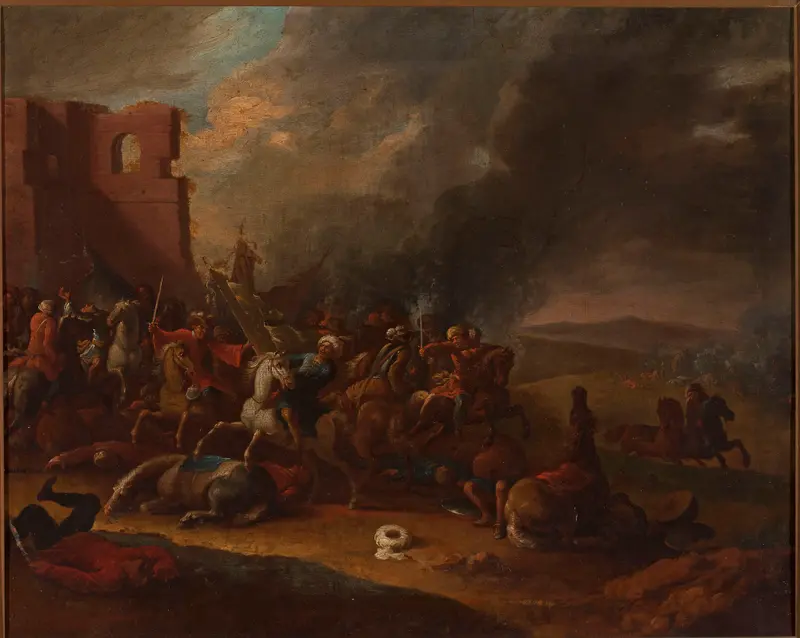
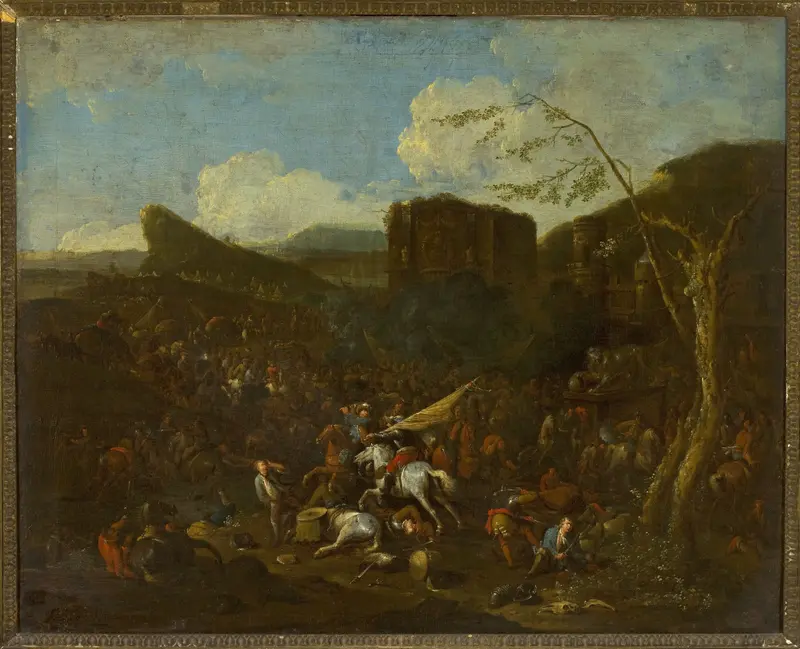
A surge of chaos sweeps the viewer into the heart of Battle of the Turks with the Poles, where the clash of armies is staged beneath the looming silhouettes of fortified towers. The eye is drawn first to the tumult of horses and figures in the foreground, a dense knot of bodies and banners where the violence of battle is rendered in swift, energetic brushwork. The arched bridge, dark and crowded, becomes a bottleneck—its stonework a silent witness to the struggle, while above, the city’s towers and distant ramparts are bathed in a golden haze.
The palette is earthy and subdued, with flashes of red and white catching the light, signaling moments of drama amid the confusion. Smoke and dust blur the boundaries between victors and vanquished, while a single tree on the left leans in, as if straining to witness the outcome. Painted between 1709 and 1719, this work by Arnold Frans Rubens belongs to a tradition of grand battle scenes that flourished in early eighteenth-century Europe. Such paintings were often commissioned to commemorate victories or to decorate the halls of nobility, serving as both propaganda and spectacle.
The genre thrived on the depiction of historical or legendary conflicts, with artists balancing documentary detail and theatrical invention. Little is recorded about the specific origins or journey of this painting, now held in the Hermitage Museum’s collection, but its energy and complexity speak to the appetite for martial heroics in an age still shaped by shifting alliances and imperial ambitions. The longer you look, the more the painting reveals its layers of movement, fear, and ambition—inviting you to lose yourself in the smoke and tumult of a vanished world.