
Birnam Wood — History & Facts
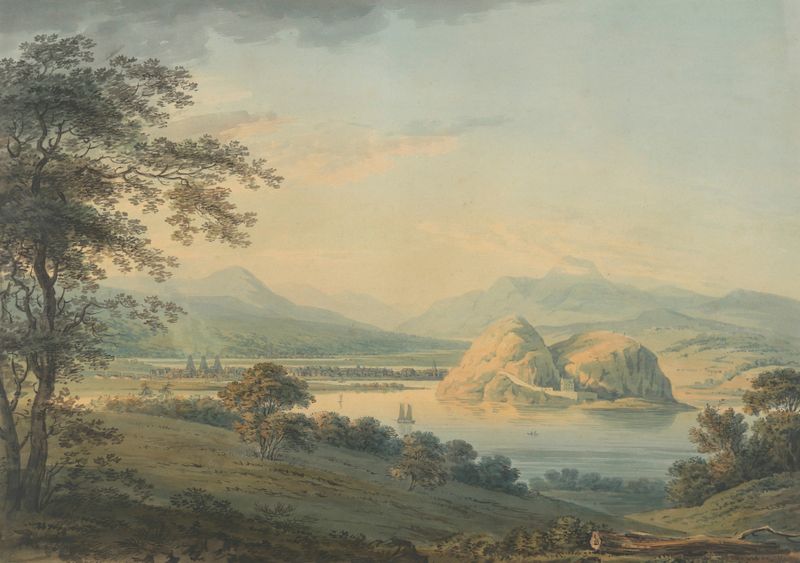
In Hugh William Williams’ Birnam Wood, a revelation unfolds, capturing the essence of a moment suspended between reality and the ethereal. Look closely at the sprawling landscape, where the rich greens of the trees contrast with the softer hues of the sky. The foreground invites your gaze with a delicate balance of shadow and light, guiding your eyes toward the distant hills that seem to recede into a dreamlike horizon. Notice the intricate brushwork that defines the foliage, each stroke breathing life into the woodlands, revealing both depth and texture that draws you deeper into the scene. Upon closer inspection, the scene reveals hidden meanings: a sense of tranquility woven with the tension of an unseen presence.
The interplay of light suggests the passage of time, hinting at changes yet to come. The composition is not merely a representation of nature but becomes a metaphor for transformation, where the viewer can sense a stirring beneath the surface, a whisper of stories waiting to be told. Created before 1801, during a period of growing interest in Romanticism and nature’s sublime beauty, Williams painted this while exploring the Scottish landscapes. The era was marked by an increasing appreciation for the natural world, paralleling the artist's own journey.
Influenced by the picturesque movement, he aimed to capture not just the aesthetic beauty of Birnam Wood, but the emotional resonance that nature evokes in the human spirit.
More Artworks by Hugh William Williams
Browse all →
Near Stirling, Scotland
Hugh William Williams

The Erechtheum, Athens
Hugh William Williams
View of Thebes
Hugh William Williams
Landscape, North Wales
Hugh William Williams
Castle in a Landscape
Hugh William Williams
View of the Forum in Rome
Hugh William Williams
View of the town and castle of Dumbarton
Hugh William Williams





