Boerenhuis te Anrath — History & Facts
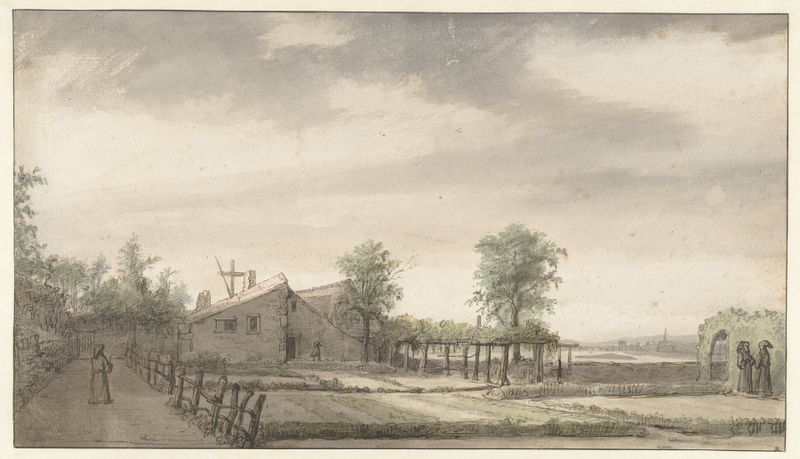
Could a single brushstroke hold eternity? In Boerenhuis te Anrath, the essence of rural life is captured with a delicate precision that feels both timeless and fleeting, inviting us into a world where the ordinary becomes extraordinary. Look directly at the humble farmhouse in the center, a sturdy structure that stands resilient against an expansive sky. Notice the subtle variations in the earth tones of the building, where warm ochres meet cooler grays, skillfully blending to evoke both comfort and solitude. The painter's brushstrokes—each laden with intention—create a textured surface that draws the eye, revealing a living canvas of fields and foliage that embrace the dwelling.
The juxtaposition of light and shadow provides a sense of depth, enhancing the illusion of space and inviting contemplation. Within this pastoral scene lies a poignant contrast between the tranquility of the farmhouse and the swirling clouds that loom above, hinting at the impermanence of life. The fields, though vibrant and lush, suggest labor and toil, while the distant horizon remains shrouded in mystery. This interplay of elements reflects the duality of existence—the peace one seeks in nature often comes hand-in-hand with uncertainty and change. During the late 1630s, while Boerenhuis te Anrath was painted, Lambert Doomer was immersed in the Dutch Golden Age, a time when artists explored realism and everyday life as subjects worthy of admiration.
Living in Amsterdam, he was influenced by the burgeoning interest in landscape painting, as well as the changes in society and the economy around him. This work exemplifies his ability to transform the mundane into a narrative filled with significance, capturing a moment that resonates across time.