Bäuerin und Hirtenjunge mit Rinder- und Schafherde am Seeufer — History & Facts
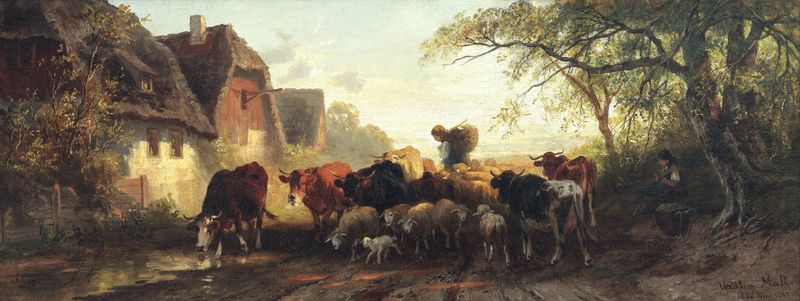
Can paint confess what words never could? In the delicate play of light and shadow, Bäuerin und Hirtenjunge mit Rinder- und Schafherde am Seeufer beckons us into a world where silence speaks volumes. Focus on the soft contours of the figures that occupy the foreground, the shepherd boy and the farmer woman, as they personify an age-old connection to the land. Notice how their postures convey a sense of intimacy and duty, while the gentle ripples of the nearby lake reflect the dappled light filtering through the trees. The choice of earth tones harmonizes with the lush greens surrounding them, enriching the pastoral scene with a sense of tranquility. Yet, beneath this serene exterior lies a juxtaposition of youthful optimism and the rugged realities of rural life.
The shadows cast by the figures hint at the burdens they carry—one of responsibility intermingled with the fleeting joys of childhood. The grazing livestock in the background serve as a reminder of the constant cycle of labor and nurturing inherent in their existence, deepening the emotional resonance of this idyllic moment. Christian Mali painted this work in 1878, during a time when the rural lifestyle was slowly being overshadowed by the industrial revolution. Based in Vienna, he sought to capture the essence of peasant life and the beauty of the natural world.
This painting reflects both his admiration for the simplicity of rural existence and a poignant awareness of the changes sweeping through society, making it a testament to an era on the brink of transformation.