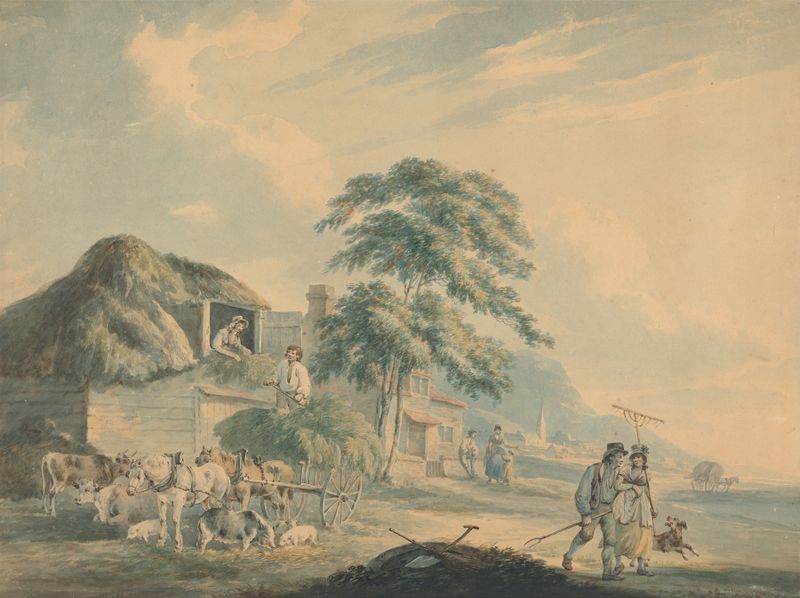
Composition: two travellers and a dog on a road passing cottages, with ruins on a hill — History & Facts
Who listens when art speaks of silence? In a world filled with noise and haste, the true essence of longing often rests in the stillness between moments. Look to the center of the piece, where two travelers stand on a winding road. Their muted garments suggest a timeless journey, while the gentle sway of the landscape draws the eye toward the cottages nestled to the left. Notice how the soft, hazy light filters through the clouds above, illuminating their path and casting long shadows that hint at the day’s end.
The artist’s delicate brush strokes create a serene atmosphere, balancing the warmth of earth tones with the cooler shades that suggest distant ruins looming on the hill. The juxtaposition of the travelers and the cottages speaks to a deeper narrative of desire and nostalgia. While the figures seem to pause in contemplation, the ruins above evoke a sense of loss and history, suggesting the passage of time and memories that linger like whispers. The dog at their feet symbolizes loyalty and companionship, grounding the scene while inviting the viewer to ponder what lies beyond their immediate surroundings.
Each element is intertwined, conveying a yearning for connection and the journey that lies ahead. In 1799, Peter La Cave created this work while living in England, a time when Romanticism was beginning to shape the art world. Influenced by the natural landscapes around him, he sought to depict the emotional depth of human experience amidst the sublime beauty of nature. This painting reflects both his personal exploration of desire and the broader artistic movement that valued the relationship between humanity and the environment.