Convoi dans les marais de Quiberon — History & Facts
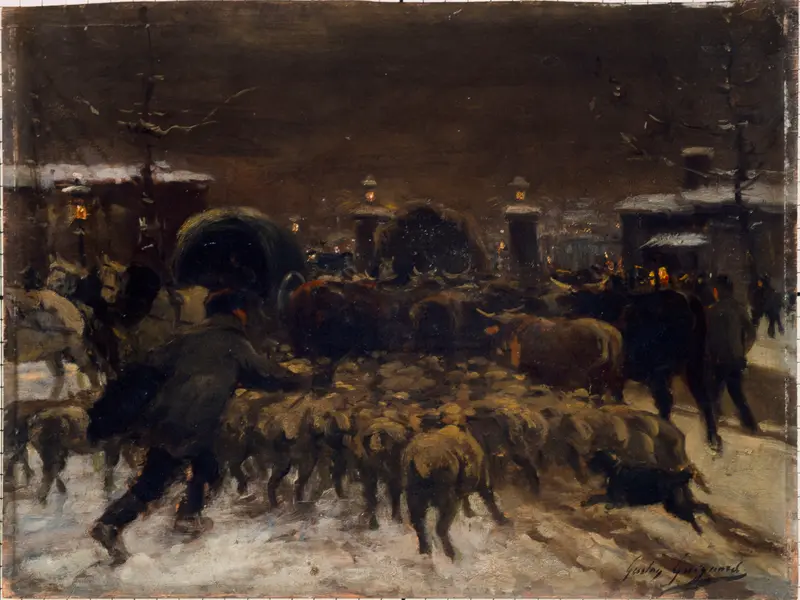
What draws the eye first in Convoi dans les marais de Quiberon is the sense of movement and struggle against the elements, all under a heavy, uncertain sky. The painter orchestrates a tense procession: soldiers on horseback, peasants, cattle, and wagons inching their way through a sodden marsh, the ground itself threatening to swallow their progress. The light is low and ochre, pooling around the central figures and picking out the glistening water and the wary faces of men and beasts alike.
Each gesture is purposeful—the raised staff of the drover, the watchful posture of the mounted guards, the careful lead of the horses—signaling vigilance, fatigue, and the need for order in a landscape that resists it. The palette is somber, all browns, greens, and greys, reinforcing the weight of the journey and the uncertainty of what lies ahead. Painted in 1883 by Alexandre Gaston Guignard, this work belongs to a tradition of late nineteenth-century French historical painting, where artists revisited the upheavals of the previous century with a new realism and attention to the ordinary participants of grand events. Such scenes were often commissioned for public display or regional museums, intended to instruct as much as commemorate, and to connect local history with national memory.
The Salon of 1883, where this painting was shown, was a stage for artists to demonstrate both technical skill and narrative power. While history has kept few traces of Guignard’s wider career, the painting’s presence in the Musée Massey, on deposit from the Musée de Pau, hints at a regional pride in these stories of endurance. The next time you look, follow the line of the cattle’s backs and the soldiers’ gaze—see how the landscape itself becomes a silent character, shaping every step.