Alexandre Entrée des troupeaux à Paris P2293 Musée Carnavalet — History & Facts
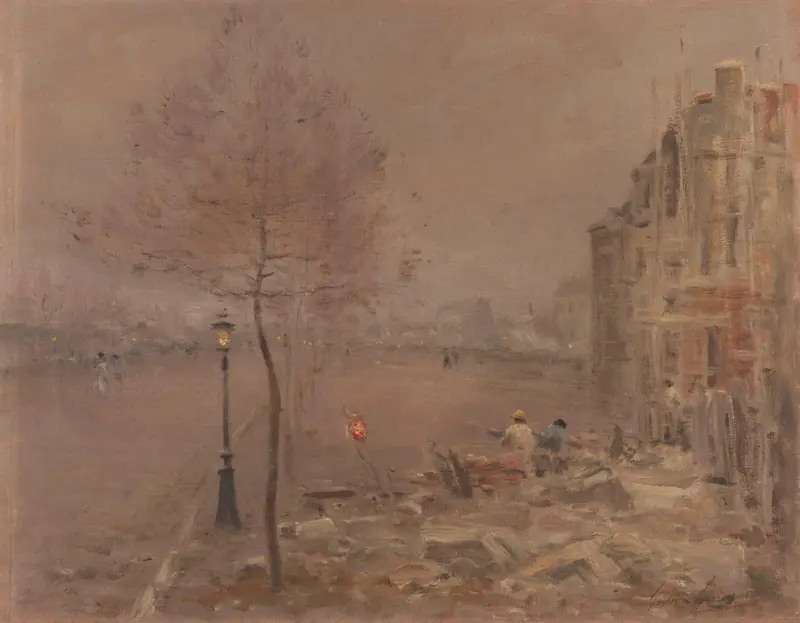
A tide of animals surges forward under the cover of night, their movement pressing against the dark, snow-dusted streets of Paris. The eye is swept up in the urgency of the flock, driven by figures whose gestures are all resolve and haste, as if the city itself waits impatiently for its daily sustenance. Lanterns flicker in the distance, their glow barely piercing the heavy dusk, while the mass of sheep and cattle blurs into a single living force.
The artist’s brushwork is loose and quick, echoing the restless energy of the scene; the muddy palette and low horizon thrust the drama into the foreground, making the viewer feel the cold and the crush. Every detail—the bent backs of the drovers, the anxious dog at work—pulls us deeper into the heart of this nocturnal procession. Painted in 1889, this work belongs to a world on the cusp of modernity, when Paris was both a city of spectacle and a place of daily, unglamorous labor. Such scenes, often commissioned for municipal pride or documentary purpose, captured the rhythms that sustained urban life: the arrival of food, the choreography of workers, the transformation of rural abundance into city commerce.
The painting is now held by Paris Musées, a fitting home for a piece so rooted in the city’s fabric. History has kept few traces of Alexandre Gaston Guignard’s career, yet here his hand preserves a fleeting moment of urban ritual—one that invites us to step into the wintery street and follow the herd through the gates of a vanished Paris.