Dune Landscape — History & Facts
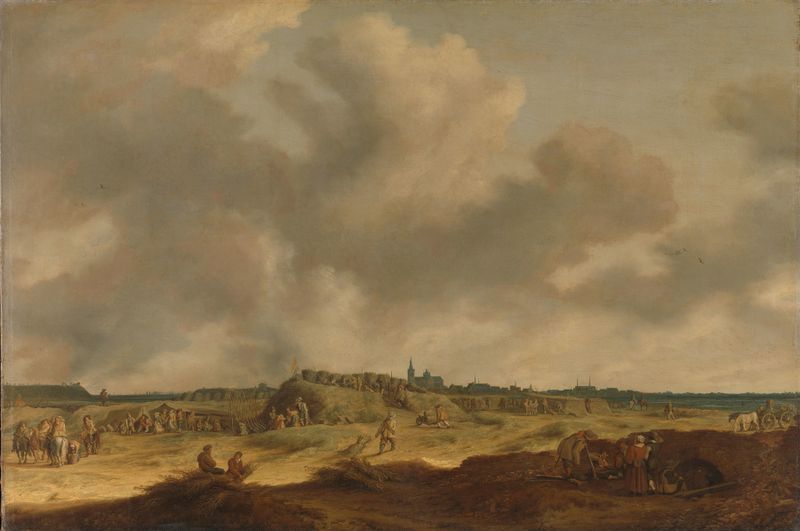
What secret hides in the quiet of the canvas? In Dune Landscape, the tranquil scene invites contemplation of life’s fleeting nature and the passage of time, as the dunes rise and fall like the breaths of existence itself. Look to the foreground, where the gentle curves of the sandy mounds draw your eye across the surface. Notice how the soft, muted tones of beige and gold blend seamlessly, creating a harmonious landscape that feels both familiar and otherworldly. The delicate strokes capture the shifting light, casting subtle shadows that enhance the texture of the undulating sand, inviting viewers to trace their fingers along unseen paths etched by the wind. In this serene setting, hidden contrasts emerge.
The expansive sky stretches above, painted in a gradient of blues, instilling a sense of infinite possibility, while the dunes, though beautiful, remind us of their impermanence. The scattered tufts of grass peeking through the sand whisper stories of resilience amid the transitory nature of the scene, asking us to ponder what lies beneath the surface. This visual dialogue speaks to the human condition—a balance between beauty and decay, life and mortality. Pieter de Neyn created Dune Landscape in 1631, during a period marked by artistic exploration in the Netherlands.
As a painter emerging in the Baroque era, he engaged with themes of nature, capturing the sublime in his landscapes. This work reflects the artist’s growing interest in depicting the natural world’s quiet majesty, alongside a contemporary fascination with the stillness that often conceals deeper truths about existence.