
Engeltje bij het been van de H. Rochus — History & Facts
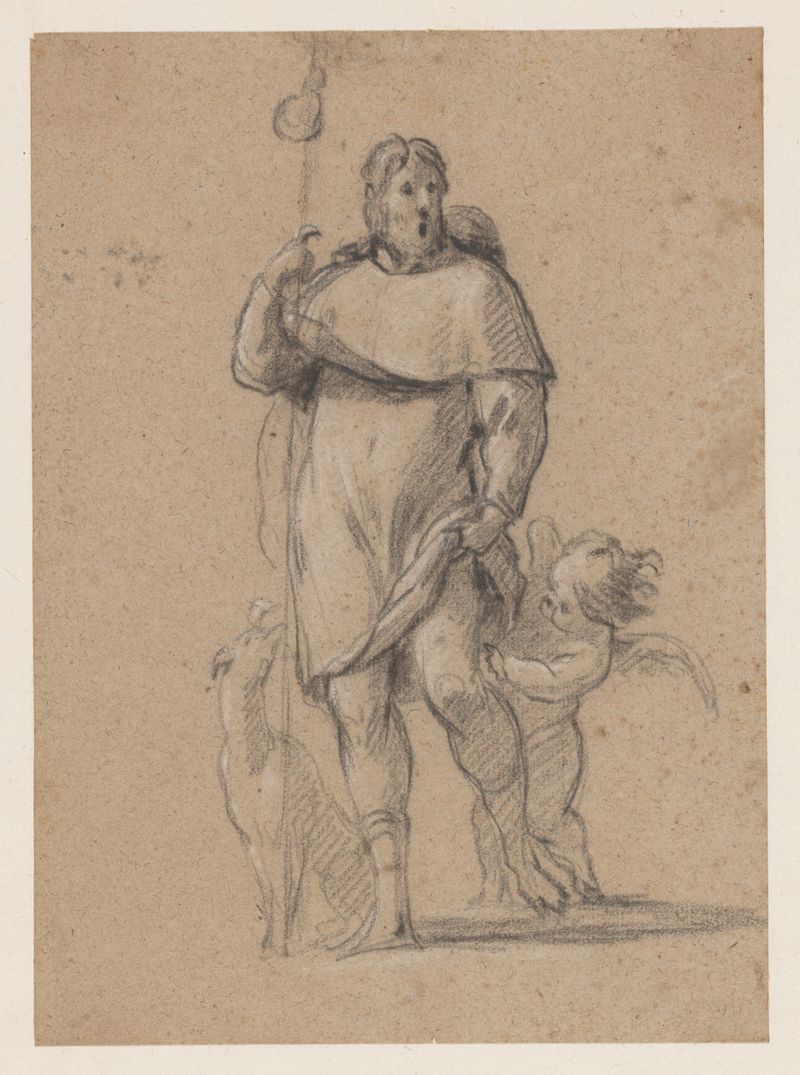
What if beauty was never meant to be finished? In the delicate brushstrokes of Engeltje bij het been van de H. Rochus, time suspends itself, inviting us to linger in the moment of creation. Look closely at the angel's playful expression, painted with soft pastels that dance against the rich, dark background. The light cascades from the left, illuminating the angel's face and creating a striking contrast with the shadowed figure of Saint Rochus.
Notice how the gentle curves of the angel's wings echo the softness in the saint’s drapery, providing a fluid harmony between the two figures. The composition draws our gaze toward the central connection, binding the ethereal and the earthly. Deeper meanings emerge as we examine the juxtaposition of innocence and vulnerability. The angel, a symbol of divine grace, rests at the feet of the saint, who wears a worried expression, embodying human frailty amidst spiritual devotion.
This contrast sparks a dialogue between celestial hope and earthly despair, questioning the nature of suffering and redemption. Each detail, from the saint's tattered robe to the angel's serene countenance, speaks volumes about the complexities of faith in turbulent times. Simon Vouet crafted this piece during a period of significant transition in European art, roughly between 1620 and 1630, while residing in Paris. Influenced by the Baroque style, he embraced dramatic lighting and emotional depth, reflecting both personal introspection and the era's cultural shifts.
The work captures not only a moment in time but the artist's exploration of beauty and spirituality amidst societal change.
More Artworks by Simon Vouet
Browse all →
Jonge vrouw (Chariclea?)
Simon Vouet

Zittende luitspelende engel
Simon Vouet
De H. Rochus met hond en engeltje
Simon Vouet

Vluchtige opzet voor een zittende faun
Simon Vouet

Studie van een buigende jonge vrouw
Simon Vouet

Twee vrouwenfiguren, zittend naar rechts
Simon Vouet

Faun of sater, zittend naar rechts
Simon Vouet

Aurora
Simon Vouet

Jongeman (Theagenes?), leunend tegen een tafel
Simon Vouet

Staand meisje dat haar rok optilt
Simon Vouet
More Religious Art
Browse all →
The Return of the Prodigal Son
Rembrandt van Rijn

The Garden of Earthly Delights
El Bosco

Count Orgaz’ funeral
El Greco

The Hundred Guilder Print: the central piece with Christ preaching, the plate arched
Rembrandt van Rijn

The Descent from the Cross
Rogier van der Weyden

The return of the prodigal son
Rembrandt van Rijn