
Staand meisje dat haar rok optilt — History & Facts
In a world filled with fleeting moments, each stroke of paint captures the essence of a lingering melancholy, urging us to pause and reflect. Look to the center of the canvas, where a young girl stands, her delicate figure partially obscured as she lifts her skirt just above her knees. The soft play of light accentuates the contours of her form, creating a gentle contrast between shadow and illumination. Notice the muted palette of earth tones and the subtle accents of color that evoke a sense of nostalgia, pulling the viewer into her quiet contemplation.
The careful rendering of fabric and skin imbues her posture with both innocence and a hint of vulnerability. As we delve deeper, the emotion within the painting unfurls. The girl’s expression holds a profound sadness, suggesting a moment caught between childhood and the encroaching complexities of adulthood. The act of lifting her skirt, a seemingly innocent gesture, poses questions of propriety and societal expectation, hinting at a loss of innocence.
The background remains intentionally vague, a soft blur that isolates her, allowing the viewer to ponder her thoughts and dreams — is she escaping or confronting something hidden beneath the surface? During the period from 1600 to 1659, Simon Vouet was establishing himself in France after returning from Italy, where he encountered the Baroque style that would deeply influence his work. This time was marked by a rich exchange of ideas in the art world, as he navigated the transition from Mannerism to a more dynamic and emotional approach. Staand meisje dat haar rok optilt embodies this evolution, capturing the tension between simplicity and depth, reflecting both personal introspection and broader societal shifts.
More Artworks by Simon Vouet
Browse all →
Jonge vrouw (Chariclea?)
Simon Vouet

Engeltje bij het been van de H. Rochus
Simon Vouet

Zittende luitspelende engel
Simon Vouet
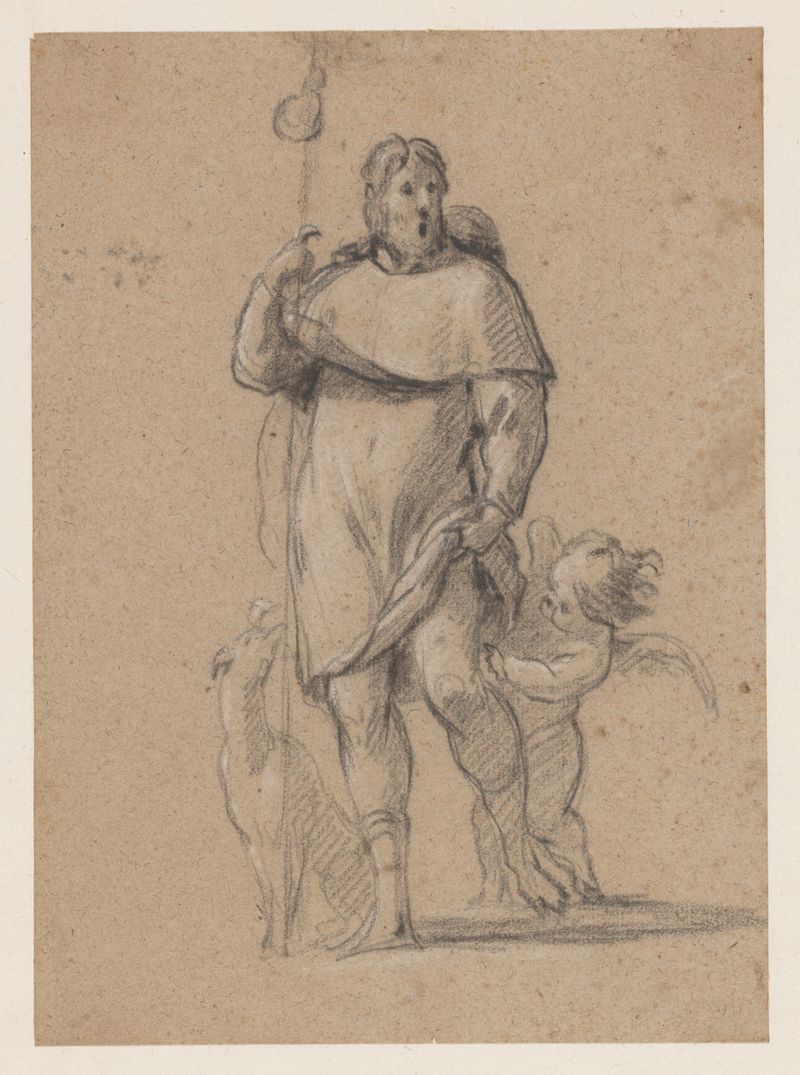
De H. Rochus met hond en engeltje
Simon Vouet

Vluchtige opzet voor een zittende faun
Simon Vouet

Studie van een buigende jonge vrouw
Simon Vouet

Twee vrouwenfiguren, zittend naar rechts
Simon Vouet

Faun of sater, zittend naar rechts
Simon Vouet

Aurora
Simon Vouet

Jongeman (Theagenes?), leunend tegen een tafel
Simon Vouet





