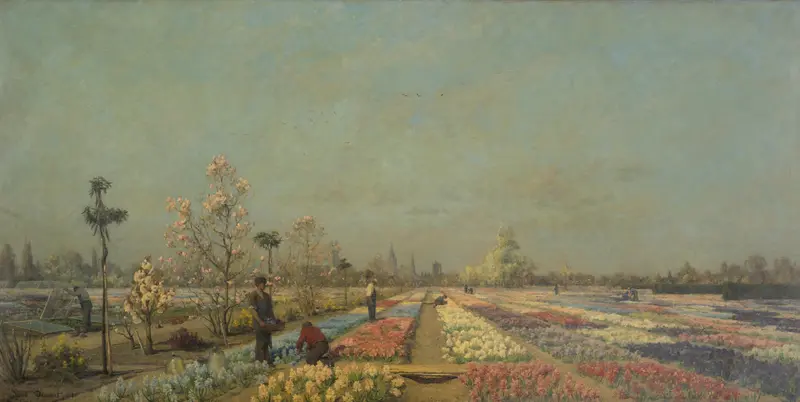
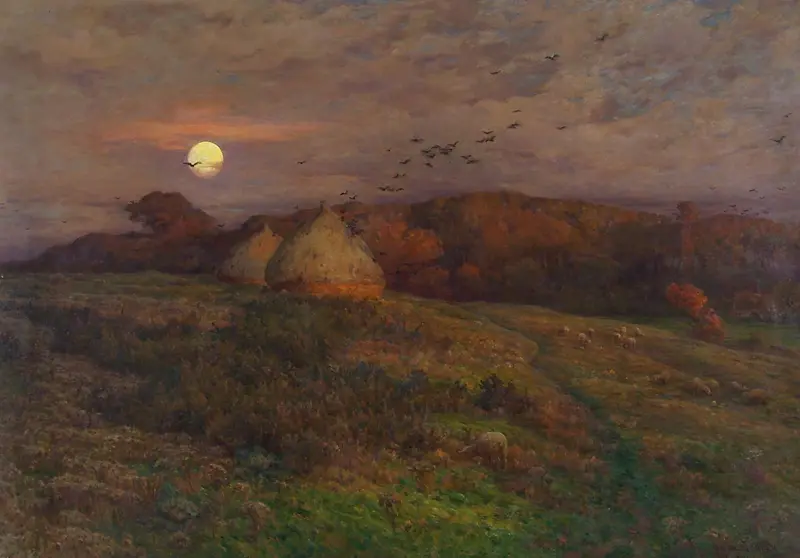
Esquisse pour l'escalier des Fêtes de l'Hôtel de Ville de Paris , Le square Cluny — History & Facts
A hush settles over the garden as dusk thickens, and the eye is drawn first to the pale, hovering sun—an orb suspended in a sky that seems to hum with the last warmth of day. In Esquisse pour l'escalier des Fêtes de l'Hôtel de Ville de Paris , Le square Cluny, Adrien-Louis Demont leads us into a world of gentle melancholy, where architectural fragments and bare trees dissolve into shadow. The building, half-lost in the gloom, stands as a silent witness; its arches and columns barely emerge from the encroaching darkness, while the overhanging branches appear to brush the sky, as if to catch the fading light.
There is a sense of pause, as if the city itself is holding its breath, and the muted palette of ochres and greens deepens the mood of quiet reflection. Painted in 1889, this work belongs to a moment when French artists were fascinated by the interplay of nature and urban memory, often capturing the old quarters of Paris just as modernity threatened to sweep them away. Sketches like this—intimate, atmospheric, and unfinished—were sometimes made for larger decorative cycles or as studies for public commissions, especially in a period when city halls and civic buildings sought to celebrate their surroundings through art. Adrien-Louis Demont’s brushwork, loose and searching, places the viewer in the heart of a city that is both present and vanishing, a mood that would have resonated with a generation witnessing rapid change.
Today, preserved in the Paris Musées collection, the sketch invites us to linger in its half-light, searching for stories in the shadows.