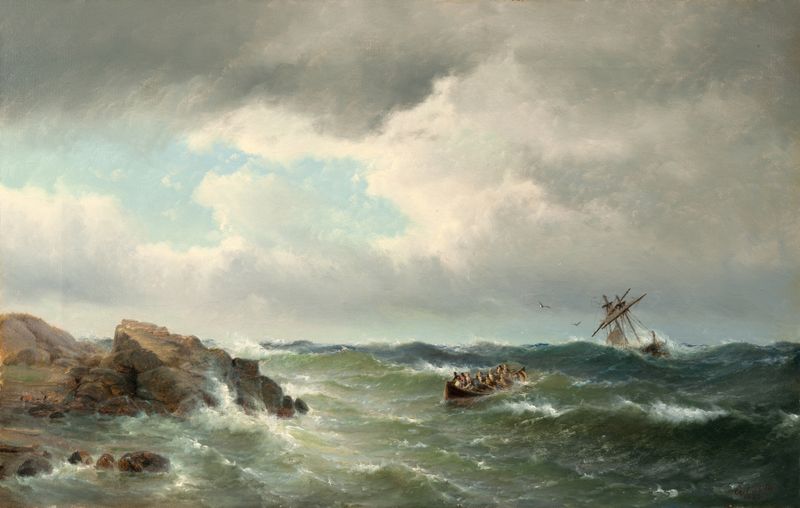
Et dampskib i en storm i Atlanterhavet — History & Facts
Where does light end, and longing begin? In the tumultuous embrace of ocean waves, one can find the weight of grief and uncertainty, rendered with poignant clarity. Look to the center of the canvas where a steamship struggles against the looming tempest, its proud silhouette almost swallowed by towering waves. The palette is dominated by deep blues and grays, swirling with energy, while shards of white foam burst against the vessel, echoing the chaos that surrounds it. The light flickers, dappling the ship's hull, hinting at a resolute hope amidst the despair of the storm. Notice the contrasting serenity on the horizon, where the sun attempts to break through the heavy clouds, casting a muted glow on the tumult.
This interplay between light and darkness encapsulates an emotional tension, mirroring the battle between human ambition and nature’s raw power. The ship, a symbol of resilience, faces not only the physical storm but also the emotional tempest within those aboard, grappling with their own fears and grief. Carl Bille painted Et dampskib i en storm i Atlanterhavet in 1863 during a time when maritime exploration was at its zenith. The world was deeply engaged in industrial advances, yet the sea still held its mysteries and dangers.
Bille, primarily known for his seascapes, infused this painting with a sense of urgency as he navigated his personal and artistic trials, reflecting the broader struggles of humanity against nature's formidable forces.