Evening of the Battle of Navarino — History & Facts
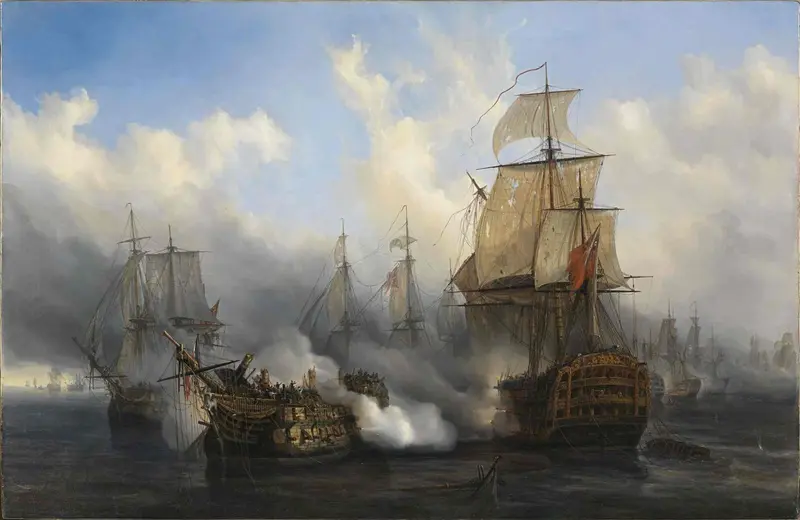
A haze of gold and smoke hangs over the water, drawing the viewer into the uneasy calm that follows catastrophe. In Evening of the Battle of Navarino, Auguste Étienne François Mayer chooses not the clash of arms but its aftermath: the wreckage of ships, the scramble for survival, and the eerie stillness that settles once the guns fall silent. Your eye is pulled first to the shattered hull in the foreground, already half-swallowed by the sea, while to its right, another vessel is consumed by fire, its timbers glowing against the dusk.
The scattered boats, crowded with desperate figures, are not just details—they are the painting’s pulse, each oar stroke a testament to human resilience and fear. The palette, dominated by ochres and browns, bathes the chaos in a melancholy light, as if the day itself mourns. Painted in 1840 and now held by the Musée national de la Marine, this work belongs to a tradition of maritime history painting that flourished in the wake of the Napoleonic era. Such paintings were often commissioned by navies, governments, or private patrons eager to commemorate moments of national significance or personal valor.
By the time Mayer painted this scene, the genre had shifted from pure celebration to a more reflective, sometimes critical, meditation on war’s cost. The artist’s focus on aftermath rather than glory speaks to changing attitudes in the mid-nineteenth century, when the spectacle of battle was increasingly shadowed by its human toll. The painting invites us to linger, to count the survivors, and to imagine the stories that drift on the evening tide.