Figures in a Building — History & Facts
When Figures in a Building was first exhibited in 1832, it surprised many of Turner’s contemporaries by its ambiguity: neither a grand landscape nor a dramatic seascape, but a quiet interior scene whose meaning remains elusive. Critics of the time struggled to categorize it, with some questioning whether the work was unfinished or intentionally enigmatic. The painting stands out in Turner’s oeuvre for its focus on human presence within architecture, rather than his usual fascination with nature’s forces.
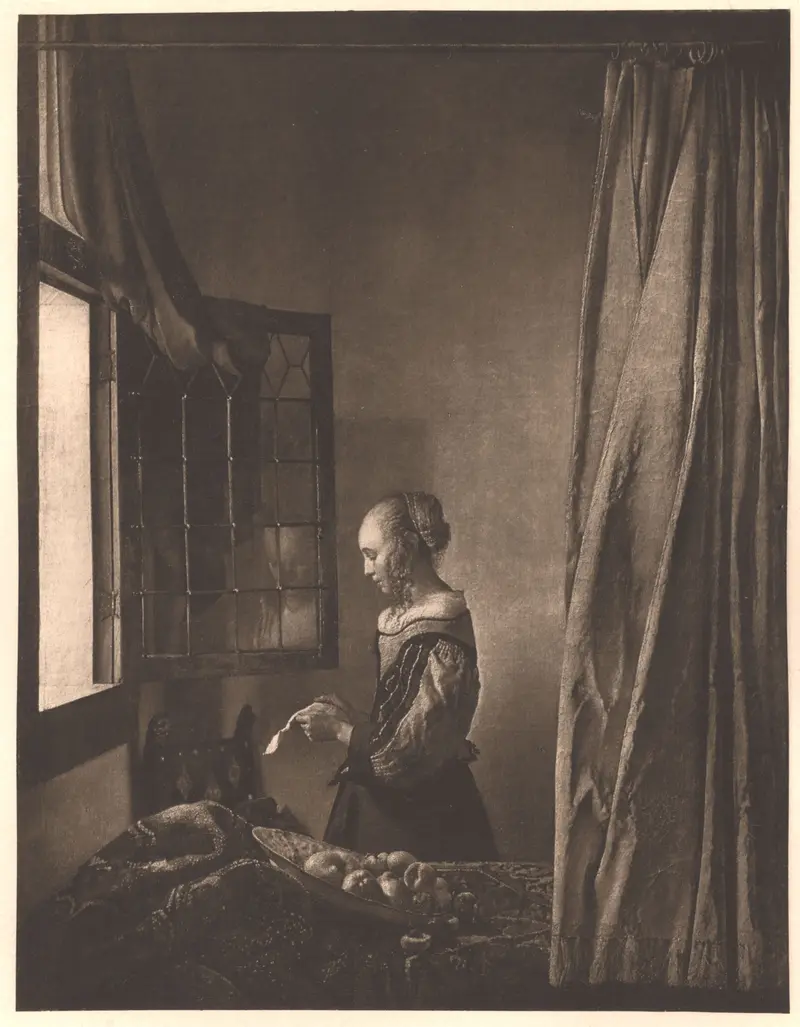
This departure has led some scholars to speculate that Turner was experimenting with new ways of representing space and narrative. At the heart of the composition, a small cluster of figures—rendered with swift, almost indistinct brushwork—gathers in a shadowed room. Light pours in from a high window, illuminating the pale walls and catching on the figures’ faces, suggesting a moment of quiet conversation or contemplation. The arrangement recalls the intimacy of Dutch Golden Age interiors, yet Turner’s handling is looser, the details dissolving into atmosphere.
The building itself is anonymous, its architecture neither grand nor humble, and the figures’ identities remain a mystery, inviting the viewer to imagine their story. In contrast to Vermeer’s precise domestic scenes, Turner’s approach is more suggestive, using light and color to evoke mood rather than narrative certainty. The medium of Figures in a Building is not definitively recorded, though it is likely oil on canvas, as was typical for Turner in this period. The painting’s provenance is uncertain; there is no record of a specific patron or early exhibition history, and it does not appear in Turner’s own sales catalogues.
Today, it is recognized as an intriguing outlier within Turner’s body of work, offering a rare glimpse into his interest in interior space and human presence. Though less famous than his landscapes, Figures in a Building continues to invite speculation and admiration for its quiet complexity.
More Artworks by Joseph Mallord William Turner

The Slave Ship
Joseph Mallord William Turner

Venice: The Giudecca Canal, Looking Towards Fusina at Sunset
Joseph Mallord William Turner

Venice with the Salute
Joseph Mallord William Turner

Rough Sea with Wreckage
Joseph Mallord William Turner

Rain, Steam and Speed – The Great Western Railway
Joseph Mallord William Turner

Fishermen at Sea
Joseph Mallord William Turner

Snow Storm: Hannibal and his Army Crossing the Alps
Joseph Mallord William Turner

London from Greenwich Park
Joseph Mallord William Turner

Childe Harold’s Pilgrimage - Italy
Joseph Mallord William Turner

The Fighting Temeraire Tugged to Her Last Berth to be Broken Up
Joseph Mallord William Turner