
Fischerdorf auf — History & Facts
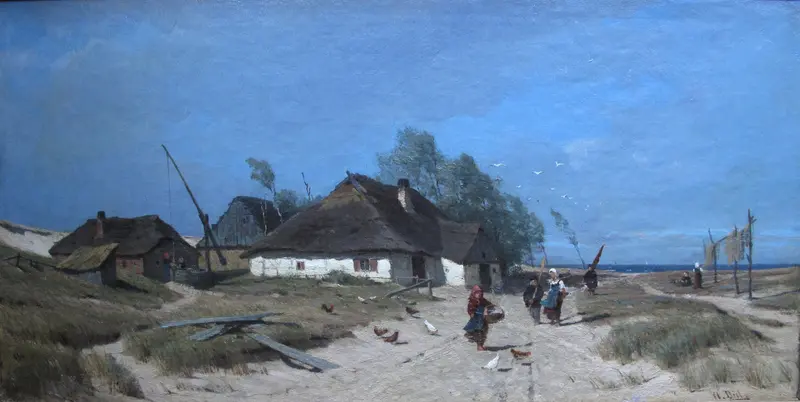
What first draws the eye in Fischerdorf auf by Antonie Biel is not the village itself, but the sky—a vast, restless dome of cloud, heavy with the promise of weather. The low horizon grants the heavens a commanding presence, dwarfing the clustered thatched huts and the curve of shoreline below. The painter leads us in a slow arc from the dark foreground, where a lone boat and scattered nets hint at the labor of fishing, to the distant, sunlit bluff that breaks through the gloom.
Every detail is a quiet signal: the stillness of the water, the birds circling low, the smoke trailing from a roof, all speak of a pause in the daily rhythm, a moment suspended between work and weather. Painted in 1866, this view likely captures a fishing village on the Mönchgut peninsula of Rügen—one of the northernmost edges of Germany, where land and sea have shaped lives for centuries. Such scenes were cherished in the nineteenth century, when artists and collectors alike turned their gaze to the working coastlines and rural landscapes that seemed threatened by the march of modernity. History has kept few traces of Antonie Biel’s career, and even less about this particular work, now preserved in a private collection and photographed for posterity in 2012.
Yet the painting’s quiet gravity invites us to linger, to imagine the stories that unfolded beneath those sweeping skies.
More Artworks by Antonie Biel

More Landscape Art

The Starry Night
Vincent van Gogh

View of Delft
Johannes Vermeer

Water Lilies
Claude Monet

The Grand Canal, Venice, looking north-west from the Ca' Corner to the Ca' Contarini degli Scrigni, with the campanile of Santa Maria della Carità
Canaletto

Windsor Castle
Canaletto

The Grand Canal looking North-East from the Palazzo Dolfin-Manin to the Rialto Bridge
Canaletto