Anlandende Fischer — History & Facts
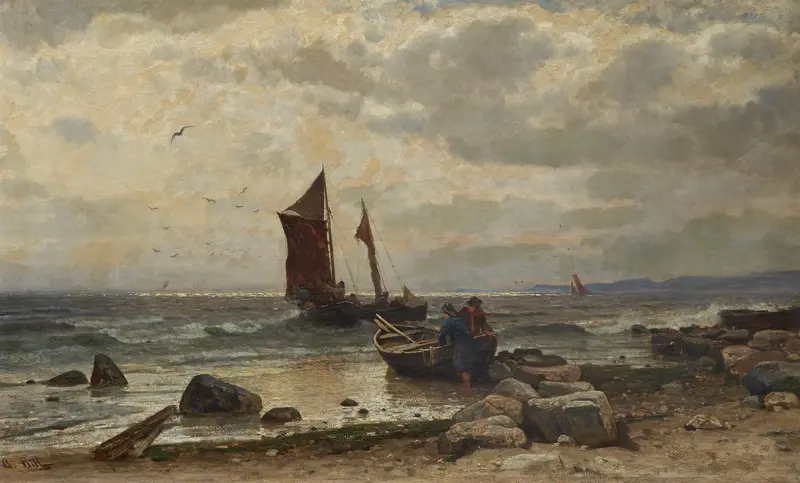
What first catches the eye in Anlandende Fischer is the hush that settles over the scene, a quiet moment suspended between sea and shore. The painter draws us in along the rough stone jetty, leading our gaze toward the cluster of figures where land meets water. The boats, their sails slack and hulls dark against the silvery light, have just arrived, and already the small community is in motion—some bent over baskets, others standing watchfully, all rendered in loose, earthy strokes that suggest the bustle of arrival without pinning down every detail.
The sky, heavy with mist, presses low, and the flight of birds overhead seems to echo the fishermen’s return, a signal that the day’s work is not yet done. Painted in the 1860s, this work belongs to a period when artists across Europe were turning their attention to the rhythms of working life and the changing relationship between people and their environment. Scenes like this—humble, everyday, yet quietly monumental—were often commissioned by patrons who sought to capture the dignity of labor or the beauty of local landscapes. Little is recorded about Antonie Biel or the specific history of this painting, but its survival in a modern collection, as documented in 2012, hints at a lasting fascination with these coastal narratives.
The viewer is left to imagine the stories behind each figure, returning again and again to the gentle interplay of light, water, and stone.