Forest landscape — History & Facts
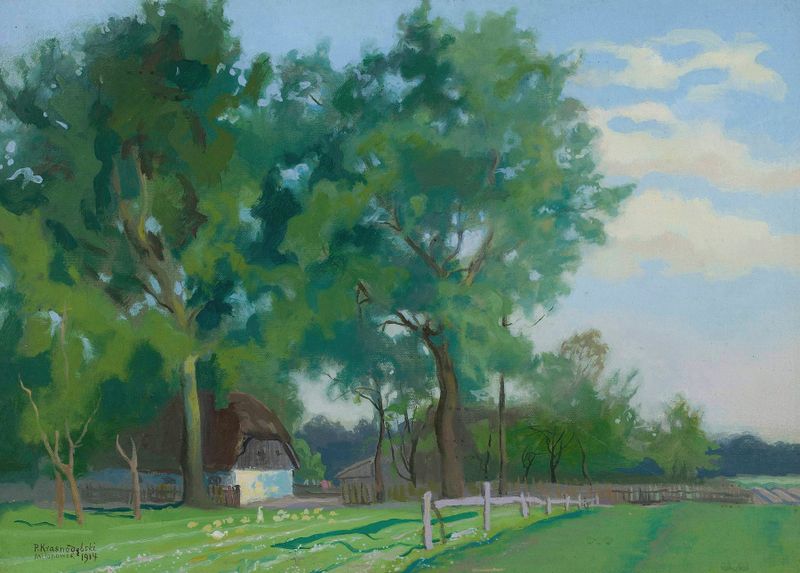
What secret hides in the quiet of the canvas? In the stillness of Forest Landscape, a sense of hope emerges from the depths of dense foliage and sun-dappled paths, inviting the observer to seek the light that pierces through the trees. Look to the left at the intricate play of greens, where each brushstroke breathes life into a variety of hues, creating a lush tapestry of nature. Notice how the towering trunks stretch upward, their bark rendered with meticulous detail, while the ground is softly illuminated by warm, golden light. The composition draws the eye inward, where shadows hold the promise of discovery and tranquility, a reminder of nature's sanctuary. Amid the greenery, contrasts abound: the rough, textured bark juxtaposes the smoothness of the underbrush, suggesting a dialogue between resilience and gentleness.
The scattered clusters of wildflowers, blooming defiantly, convey a whisper of joy in a world often weighed down by uncertainty. The stillness of the scene is punctuated by the fleeting moments of light, infusing the canvas with an ethereal quality that embodies the spirit of renewal. In 1913, Piotr Hipolit Krasnodębski painted this work amid a burgeoning revival of interest in landscape and naturalism within the art world. Living in Poland, he navigated the complexities of an era marked by political upheaval.
With a focus on the beauty of the natural world, he sought to evoke a sense of peace and introspection through his art, capturing the essence of hope in a time of change.