Forest Landscape with Hermitage — History & Facts
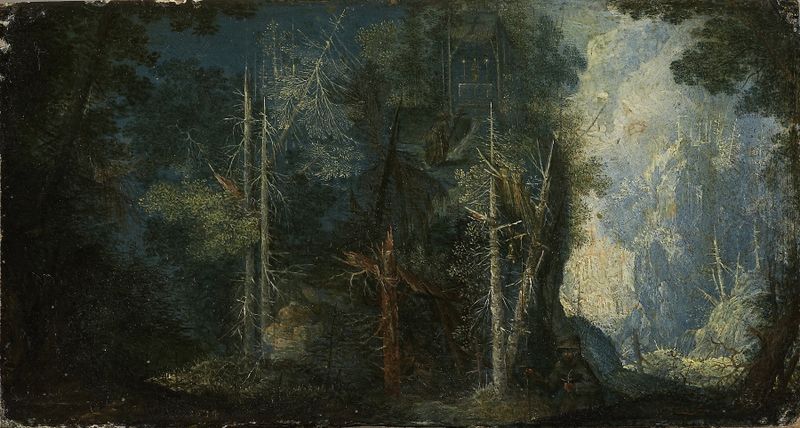
Could beauty survive in a century of chaos? In Forest Landscape with Hermitage, a serene refuge emerges amidst the tumult of 17th-century Europe, where nature cradles a simple dwelling, hinting at the promise of destiny. Look to the left at the gentle sweep of the trees, their emerald canopies blending seamlessly with the cool blues of the sky. Notice how the artist masterfully layers textures—the rough bark of the trees juxtaposed against the soft, inviting surface of the light filtering through the leaves. The hermitage, nestled in the foreground, draws the eye with its modest charm, a symbol of solitude and contemplation surrounded by the vibrant life of the forest.
Each brushstroke speaks to a meticulous attention to detail, capturing the play of light and shadow that breathes life into this tranquil scene. Yet, lurking beneath the surface is an exploration of solitude and the human condition. The hermitage stands as a testament to individual refuge, juxtaposed against the wild, untamed landscape, suggesting that even in chaos, there exists a sanctuary of peace. The light illuminating the dwelling serves as a metaphor for hope amidst uncertainty, inviting the viewer to reflect on the fragility and resilience of life. Pieter Stevens painted this work in 1614, during a period of both personal and artistic growth.
Residing in the Low Countries, he was part of a vibrant artistic community navigating the transition from the Mannerist style to the emerging Baroque. This landscape reflects not only the evolving tastes of his era but also the deep-rooted belief in the restorative power of nature, even as the world around him was rife with conflict and change.