
Fraud in the Garden — History & Facts
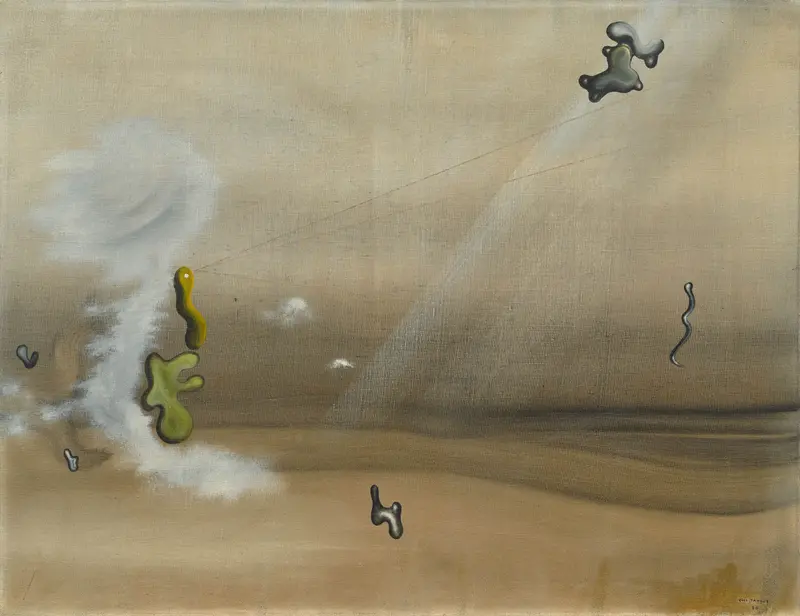
Fraud in the Garden is a 1930 oil on canvas painting by Yves Tanguy. The composition features a sparse, dreamlike landscape dominated by biomorphic forms and abstract shapes. The scene is rendered in muted tones of beige, grey, black, and ochre, with the forms casting deep, irregular shadows across an empty, pale ground.
The upper portion of the canvas transitions into a dark, gradient sky, further emphasizing the surreal isolation of the figures. The painting displays several elongated, organic structures rising from the lower left and right, their contours fluid and ambiguous. These forms appear to float or stand in a barren, undefined space, their shadows sharply contrasting with the soft background. The overall effect is one of ambiguity and strangeness, with no clear narrative or recognizable subject matter, characteristic of Tanguy’s Surrealist style. Created during the height of the Surrealist movement in Paris, Fraud in the Garden reflects the movement’s interest in the unconscious and the irrational.
Yves Tanguy was known for his meticulous technique and imaginative landscapes, which often evoke a sense of otherworldliness. The painting is representative of the artist’s output around 1930, a period marked by his close association with leading Surrealist figures.
More Artworks by Yves Tanguy

More Landscape Art

The Starry Night
Vincent van Gogh

View of Delft
Johannes Vermeer

Water Lilies
Claude Monet

The Grand Canal, Venice, looking north-west from the Ca' Corner to the Ca' Contarini degli Scrigni, with the campanile of Santa Maria della Carità
Canaletto

Windsor Castle
Canaletto

The Grand Canal looking North-East from the Palazzo Dolfin-Manin to the Rialto Bridge
Canaletto