
French Commanders at the Siege of Rheinberg, 1672 — History & Facts
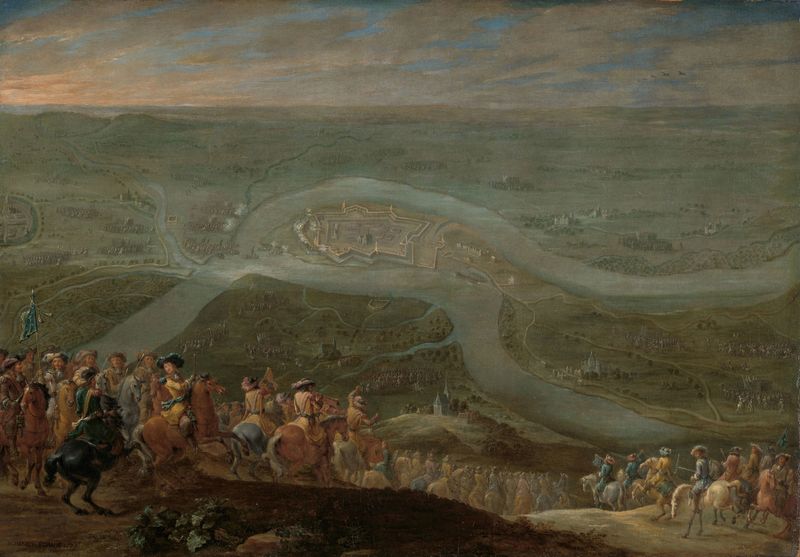
Within the canvas, a moment of historical truth stands frozen, inviting viewers into a narrative that transcends time and place. The portrayal of commanders, poised at the brink of battle, speaks volumes about human resolve and the weight of leadership amidst chaos. Look to the center, where the figures of the French commanders dominate the canvas; their stern expressions and commanding postures draw the viewer's eye immediately. Notice how the artist employs a subtle yet striking palette of earth tones and muted blues, evoking a sense of realism.
The delicate interplay of light and shadow accentuates the tension in their stance, while the carefully rendered details in their uniforms hint at both authority and vulnerability. The composition balances the figures against a backdrop of tumult, suggesting the imminent clash of wills. Delve deeper into the expressions of the commanders, which convey a spectrum of emotions—determination, anxiety, and perhaps even doubt. The juxtaposition of their ironclad resolve against the chaos surrounding them highlights a profound truth about leadership: it is often forged in the crucible of uncertainty.
The distant landscape, filled with the ominous hints of warfare, serves as a reminder of the stakes at play, where personal ambition meets existential dread. Created around 1675, this work emerged during a tumultuous period in European history, marked by power struggles and military conflicts. Lambert de Hondt II painted this piece while the Franco-Dutch War raged, capturing a pivotal moment in the siege of Rheinberg. Amidst the shifting tides of political alliances and artistic evolution, the painting stands as a testament to the complex interplay of power and responsibility in times of strife.
More Artworks by Lambert de Hondt II
Browse all →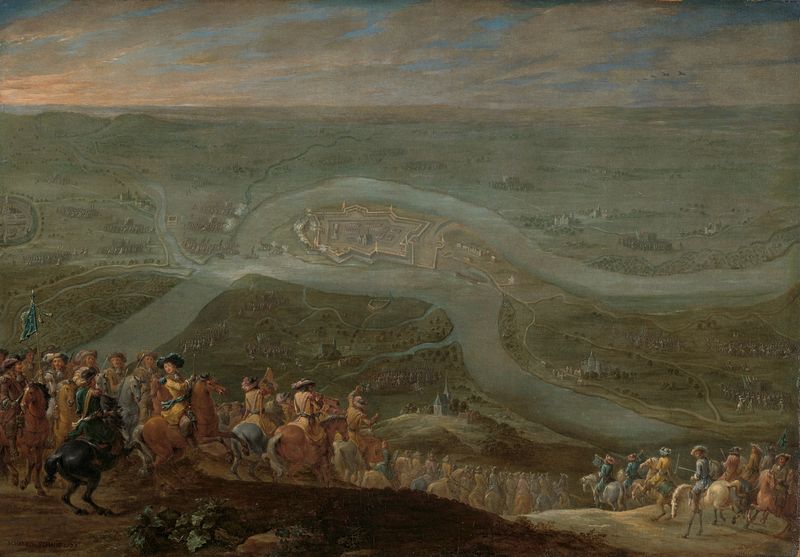

More Historical Art
Browse all →
The Night Watch Militia Company of District II under the Command of Captain Frans Banninck Cocq
Rembrandt van Rijn

Lincoln Memorial
Henry Bacon

The Third of May 1808
Francisco de Goya

Isaac and Rebecca, Known as ‘The Jewish Bride’
Rembrandt van Rijn

The Charge of the Mamelukes (1814)
Francisco de Goya

De vier ruiters van de apocalyps
Albrecht Dürer