
French Commanders at the Siege of Rheinberg, 1672 — History & Facts
Could a single brushstroke hold eternity? In French Commanders at the Siege of Rheinberg, 1672, the echoes of conflict and the whispers of rebirth unfold with each careful stroke, revealing a vivid tableau of power and strategy. Look to the center of the canvas, where the commanding figures of French generals dominate the composition, their resolute faces captured in sharp detail. The interplay of light and shadow emphasizes their ornate military garb, a kaleidoscope of rich blues, deep reds, and shimmering golds. Surrounding them, the muted tones of the landscape contrast sharply with their vibrant presence, guiding the viewer's gaze to the preparations for battle that transpire in the background, each detail meticulously rendered to evoke the tension of the scene. The tension between authority and vulnerability is palpable here, as the commanders are not merely depicted as figures of strength but also as leaders burdened by the weight of their decisions.
Notice the subtle expressions on their faces, revealing the anxiety that often accompanies ambition. The looming clouds above signify not just the threat of warfare, but also suggest an impending rebirth—of nations, of lives, and of ideologies, as empires rise and fall within the relentless march of history. Lambert de Hondt II painted this significant piece around 1675, during a time when France was securing its power under Louis XIV. The artist, who was entrenched in the vibrant artistic community of the Dutch Golden Age, sought to capture not just the events of war but also the complex dynamics of leadership during turbulent times.
His work serves as both a historical document and a reflection on the cyclical nature of power amidst the chaos of human endeavors.
More Artworks by Lambert de Hondt II
Browse all →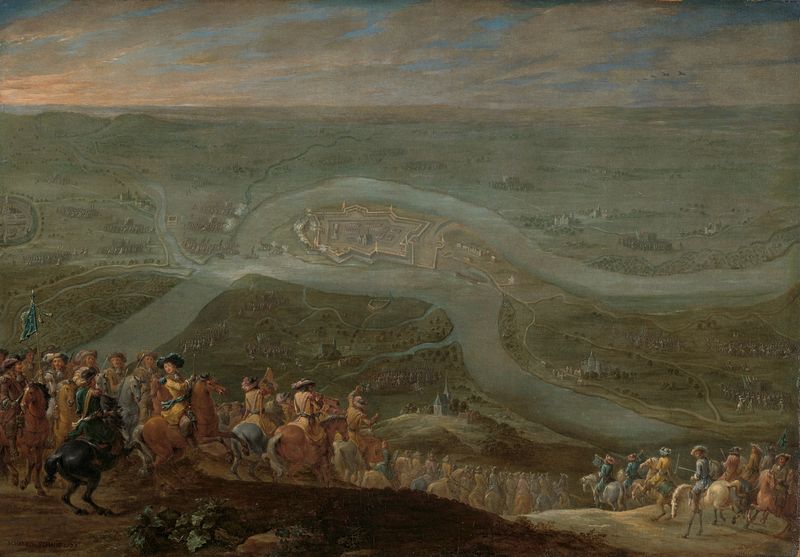
More Historical Art
Browse all →
The Night Watch Militia Company of District II under the Command of Captain Frans Banninck Cocq
Rembrandt van Rijn

Lincoln Memorial
Henry Bacon

The Third of May 1808
Francisco de Goya

Isaac and Rebecca, Known as ‘The Jewish Bride’
Rembrandt van Rijn

The Charge of the Mamelukes (1814)
Francisco de Goya

De vier ruiters van de apocalyps
Albrecht Dürer