
King Louis XIV and his Entourage at the Siege of Schenkenschans, 1672 — History & Facts
Did the painter know this moment would outlive them? The weight of history presses in on each figure, whispering of loss amid the grandeur. Look to the left at the imposing figure of Louis XIV, his ornate cloak cascading down to the ground. His piercing gaze commands attention, flanked by elegantly adorned courtiers who, though regal, seem mere shadows in his presence. Notice how the rich browns and golds dominate the palette, evoking a sense of opulence that contrasts starkly with the muted greens of the battlefield.
De Hondt’s meticulous attention to detail brings life to the embroidery and armor, drawing the eye into the intricate textures. Beneath the surface of this elaborate tableau lies a poignant narrative of ambition and mortality. The juxtaposition of the king's grandeur against the backdrop of conflict hints at the fragility of power, suggesting that even the most illustrious reign is but a moment in time. The somber expressions of the courtiers reveal an undercurrent of anxiety—what triumphs may be overshadowed by the impending toll of war? Each figure seems to wrestle with the duality of celebration and dread, weaving a complex emotional tapestry. Lambert de Hondt II created this piece around 1675, shortly after the Siege of Schenkenschans, a significant event during the Franco-Dutch War.
At this time, the artist was part of a flourishing Dutch art scene, reflecting the era's fascination with heroic imagery and royal patronage. The intricate style speaks to the Baroque period's emphasis on drama and detail while capturing the essence of an ambitious monarch navigating both glory and uncertainty.
More Artworks by Lambert de Hondt II
Browse all →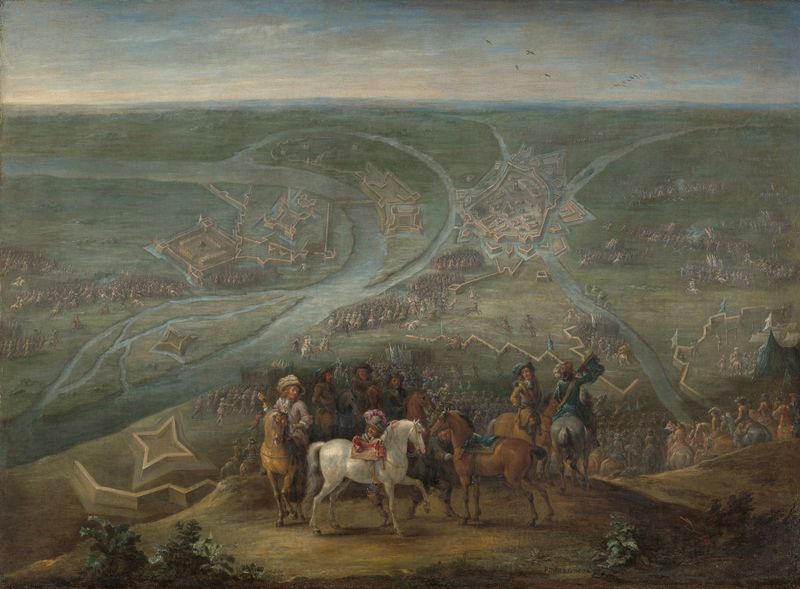

More Historical Art
Browse all →
The Night Watch Militia Company of District II under the Command of Captain Frans Banninck Cocq
Rembrandt van Rijn

Lincoln Memorial
Henry Bacon

The Third of May 1808
Francisco de Goya

Isaac and Rebecca, Known as ‘The Jewish Bride’
Rembrandt van Rijn

The Charge of the Mamelukes (1814)
Francisco de Goya

De vier ruiters van de apocalyps
Albrecht Dürer