Girl from the Kempen — History & Facts
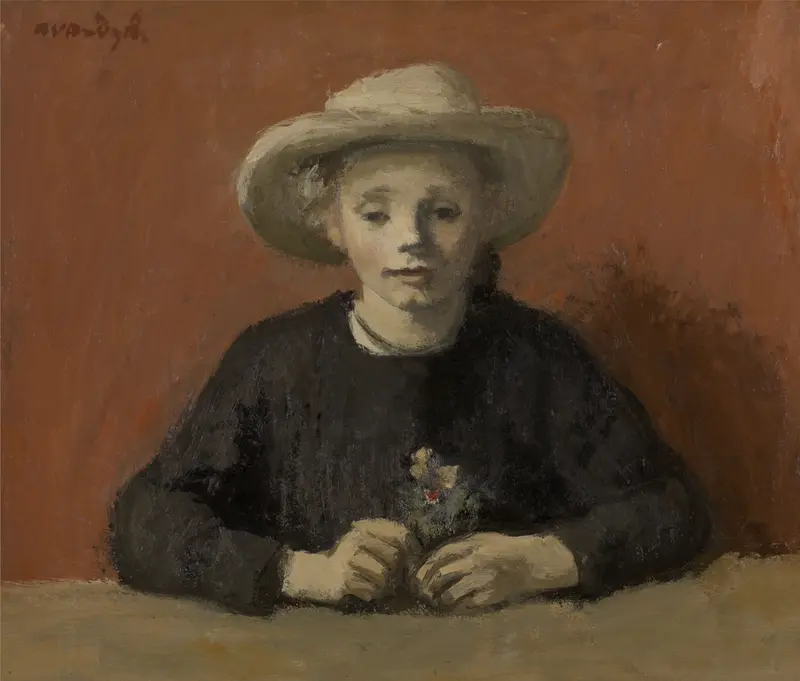
What first catches the eye in Girl from the Kempen by Albert Van Dyck is the quiet gravity in the sitter’s gaze, a look that seems to drift somewhere just beyond the viewer’s reach. Her hands, folded in her lap and gently clutching a small flower, anchor the composition in a moment of stillness. The orange of her cardigan glows against the muted green background, drawing the viewer’s attention to her presence and the subtle tension in her posture.
Light falls softly across her face, revealing both youth and a seriousness that feels older than her years. Every detail—the parted lips, the shadow beneath her chin—adds to the sense of a private world, caught in a rare moment of pause. Painted between 1925 and 1941, this work belongs to a period when artists across Europe were turning their attention to ordinary people, often from rural regions, as subjects worthy of quiet dignity. The Kempen, a region in Belgium, was known for its rustic landscapes and modest way of life, and portraits like this one offered a counterpoint to the noise of modernity.
Albert Van Dyck was part of a generation that sought to capture the soul of their homeland through direct observation and honest brushwork. Today, the painting resides in the collection of the KMSKA, a reminder of a time when even the most unassuming sitter could command the full attention of the artist—and now, of us.