
Glomma ved Åmot — History & Facts
Can beauty exist without sorrow? The landscape invites us to ponder this profound question, as the quiet elegance of nature unfolds with an irresistible tension. Look to the left at the gentle curve of the river, its surface shimmering like liquid glass under the soft embrace of dawn. The crisp air is palpable, drawing your gaze towards the distant hills that cradle the scene, painted in rich greens and earthy browns. Notice how the delicate brushwork reveals the textures of the trees, each leaf a testament to life's intricate detail, while the sky transitions from the muted tones of night to the vibrant promise of daybreak. Yet, amidst the serene beauty, a sense of melancholy lingers.
The stillness of the river contrasts with the rolling clouds overhead, hinting at a shifting mood, perhaps a storm brewing just out of sight. The lone figure in the foreground, lost in contemplation, evokes the profound solitude that often accompanies moments of reflection. Tidemand masterfully balances these elements, illustrating how joy and sorrow coexist, each enhancing the other within the tapestry of life. In 1843, Tidemand was deeply engaged with the Romantic movement, exploring the intersection of nature and humanity.
Working in Norway, he captured not just the landscape but the spirit of a nation grappling with its identity amid rapid change. This period was marked by burgeoning nationalism and a longing for cultural roots, infusing his art with a sense of purpose that resonates through Glomma ved Åmot.
More Artworks by Adolph Tidemand
Browse all →
Bridal Procession on the Hardangerfjord
Adolph Tidemand

Fra Haugsbygd
Adolph Tidemand

Domkirkeruinen, Hamar
Adolph Tidemand
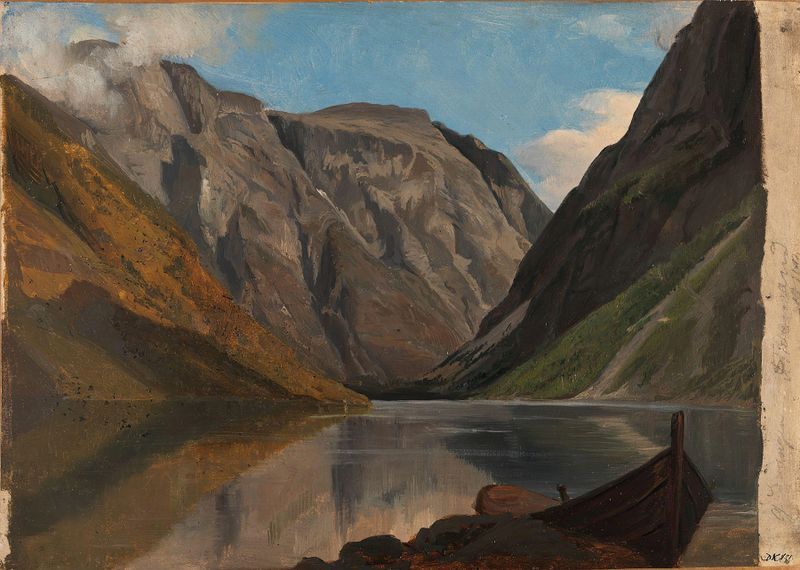
View of Gudvangen
Adolph Tidemand

Hagestad prestegård, Ulvik i Hardanger
Adolph Tidemand

View from Gudvangen
Adolph Tidemand

Fra Gulsvik
Adolph Tidemand

From Kullen in Sweden
Adolph Tidemand

Country Road
Adolph Tidemand

Untitled
Adolph Tidemand





