Hannah Fisher Stedman — History & Facts
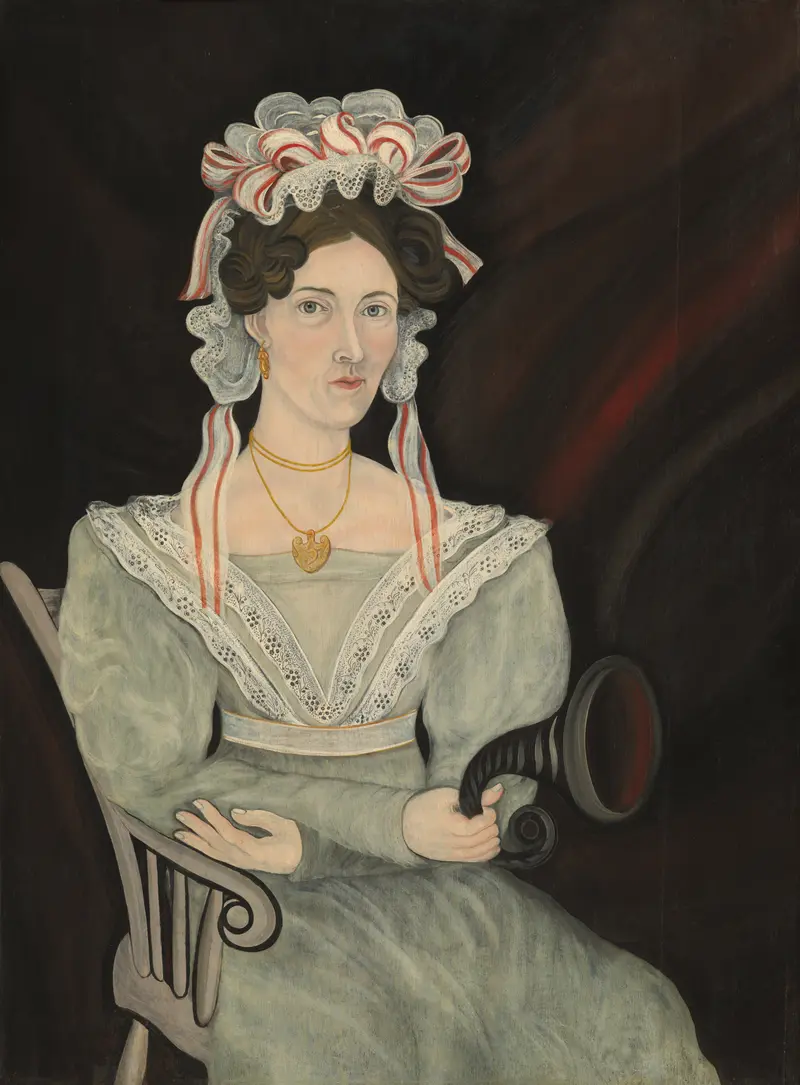
What draws the eye first in Hannah Fisher Stedman is the unwavering directness of her gaze—a rare candor in early nineteenth-century American portraiture. Her face, rendered with careful attention to symmetry and light, emerges from a dark, almost theatrical background, the pale oval of her skin set off by a crisp white collar and a bonnet tied neatly beneath her chin. The artist, Asahel Lynde Powers, chooses not to flatter or embellish: the sitter’s features are honest, her expression composed but alert, as if she has been interrupted mid-thought.
The hands, folded with quiet discipline, rest atop a book, hinting at literacy and inner life. The palette is restrained, the brushwork precise, focusing all attention on the sitter’s presence and the subtle interplay of light across her face and clothing. Painted in 1833, this portrait belongs to a period when American society was rapidly changing—westward expansion, religious revival, and the rise of a middle class eager to record its likenesses for posterity. Portraits like this were often commissioned by families to commemorate a loved one’s youth or mark a significant life event, and itinerant artists such as Powers traveled from town to town, offering their services.
The work now resides in the collection of the National Gallery of Art, a testament to the enduring appeal of these intimate records of ordinary lives. History has kept few traces of Hannah Fisher Stedman herself, but the painting’s quiet dignity invites us to imagine her world, and to look again into those steady eyes.