Hühnerhof im Dachauer Land — History & Facts
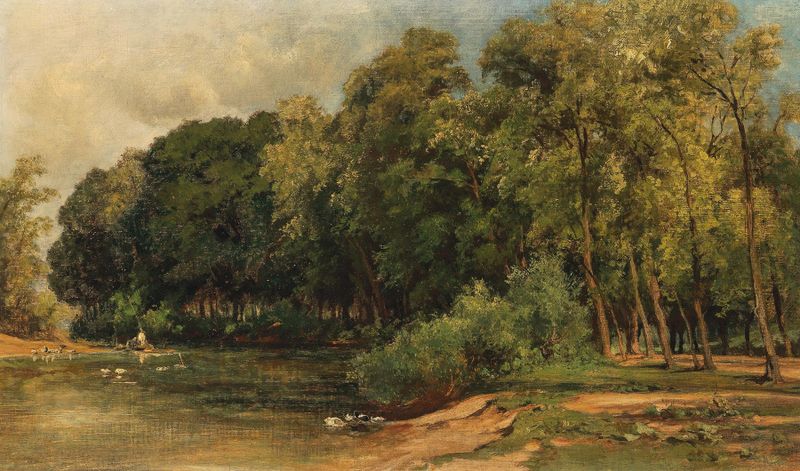
Beauty lies in the quiet observation of everyday life, where simplicity reveals profound truths. Look to the foreground, where a group of hens pecks contentedly at the earth, their feathers rendered in rich, earthy tones that harmonize with the muted greens and browns of the landscape. Notice how the sunlight filters through the trees, illuminating patches of grass and casting gentle shadows that bring a sense of depth to the scene. The composition draws your eye along the gentle curves of the field, inviting you to explore the tranquil rhythm of rural existence. Delve into the contrasts at play — the vibrancy of life against the backdrop of nature's calm, the domesticated chickens juxtaposed with the wildness of the surrounding fields.
Each hen seems to embody a quiet strength, a reminder of life’s tenacity amid the simplicity of farm life. This artwork captures not just a moment in time but a celebration of beauty found in the mundane, inviting viewers to reflect on the richness of everyday experiences. In 1872, Kappis painted this work during a period when the German art scene was evolving, embracing naturalism and the beauty of rural landscapes. Living in Dachau, near Munich, he was influenced by the burgeoning Impressionist movement while remaining firmly rooted in a love for the pastoral scenes of his homeland.
This piece stands as a testament to his commitment to capturing the essence of rural life, marrying technical skill with emotional depth.