Hillside — History & Facts
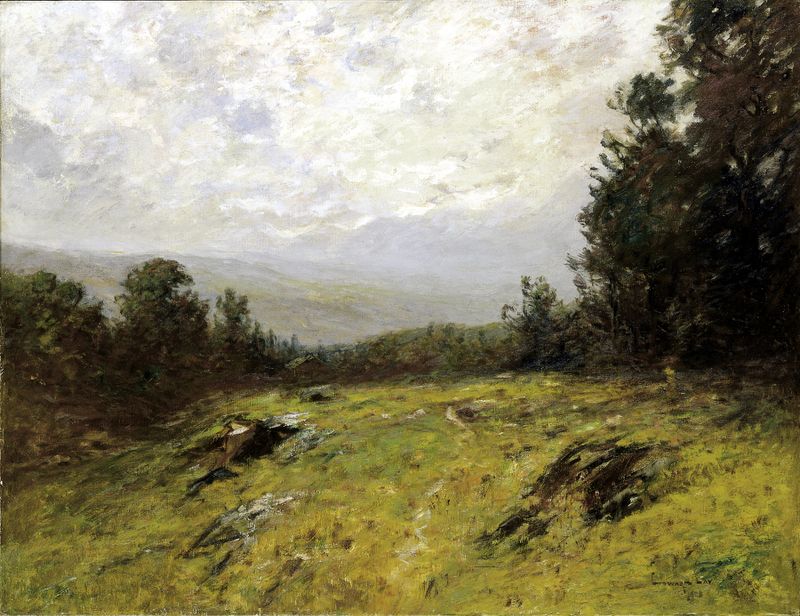
Is this a mirror — or a memory? In Edward Gay’s Hillside, time seems suspended, inviting viewers to contemplate the fragile boundary between life and death, presence and absence. Look to the left where soft, worn greens and muted browns create a gentle slope, drawing the eye toward the horizon. Notice how the light dances upon the textured surface of the hillside, revealing a nuanced palette that evokes both serenity and a quiet sense of unease. The composition is carefully balanced, with the subtle play of shadow adding depth and inviting one to explore the layers of nature’s repose. Upon closer inspection, the painting unfolds hidden narratives woven into its fabric.
The hazy distance hints at an elusive past, while the vibrant foreground clashes with the ethereal sky, reflecting the tension of existence itself. Here, the convergence of life’s beauty and its inevitable decay resonates deeply, as if the artist is whispering the secrets of mortality, urging us to acknowledge the fleetingness of all things. In 1908, Gay was painting in a period marked by an emerging interest in American Impressionism, yet he sought a deeper connection to the themes of memory and transience. Working during a time of personal and artistic exploration, he infused his landscapes with a sense of introspection, creating works that went beyond mere representation.
This painting reflects both his individual journey and the broader currents in the art world, where nature often served as a vessel for deeper existential contemplation.