Iland! Motiv Fra Skagens Sønderstrand. Frisk Tiltagende Kuling — History & Facts
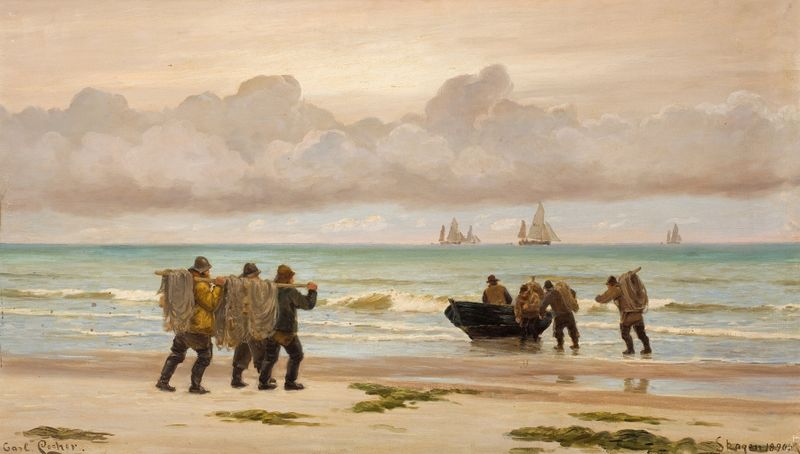
On the windswept shores of Skagen, where the North Sea collides with memory, Carl Locher captures both the transience of life and the enduring power of art. Look to the left, where dark clouds loom ominously over the tumultuous waves, their edges frosted with white. The stark contrast of deep grays and muted earth tones against the vibrant cerulean sky reveals Locher's mastery of color and his acute awareness of nature's emotional resonance. The figures in the foreground, mere silhouettes against the sweeping landscape, evoke a sense of vulnerability, reminding us of humanity's smallness in the face of nature's vastness. As you explore further into the painting, consider the way the tumultuous sea mirrors the internal struggles of existence.
The frail human forms, caught in the raw energy of the storm, suggest both resilience and fragility, embodying the tension between life’s relentless forces and our desire to belong. The tumultuous winds, visually rendered through bold brushstrokes, emphasize the relentless passage of time that we strive to reclaim yet ultimately cannot. In 1899, while painting Iland! Motiv Fra Skagens Sønderstrand. Frisk Tiltagende Kuling, Locher was part of a vibrant community of artists in Skagen, Denmark, who sought to depict the local landscape and its inhabitants.
At this time, he was influenced by the naturalism that permeated European art, yet his works often ventured into the exploration of deeper themes such as mortality and the human condition, reflecting a world on the cusp of modernity and change.