Italienische Landschaft mit Mönchen — History & Facts
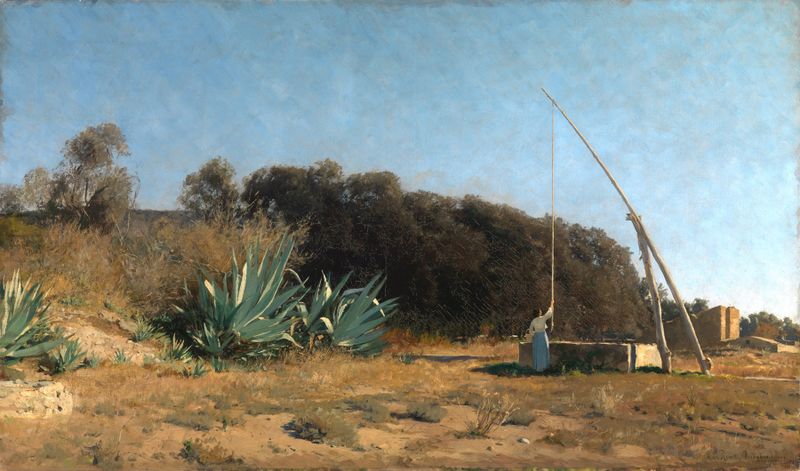
Did the painter know this moment would outlive them? In Italienische Landschaft mit Mönchen, the tranquility of a pastoral scene belies the tumultuous waves of revolution echoing beyond its borders. The landscape, serene yet charged, invites the viewer to ponder the passage of time and the enduring legacy of art amidst upheaval. Look to the left at the winding path that leads the eye through lush, verdant hills. The soft brushstrokes create a sense of movement, drawing you toward the monks, whose dark robes contrast sharply with the vibrancy of the landscape.
Notice how the light cascades upon the gentle slopes, illuminating the scene with a warm, golden hue that brings a sense of peace, despite the unrest looming outside the frame. The composition is balanced, with the monks grounding the scene, their presence suggesting contemplation of life’s deeper questions against nature's backdrop. Yet within this serene portrayal lies a tension between stillness and the broader context of revolutionary fervor stirring across Europe. The monks’ quietude contrasts with the chaotic forces of change, reminding us of the fragility of peace.
A solitary tree on the right stands resilient, symbolizing hope and endurance amid the shifting tides of history. The peaceful landscape may be a refuge, but it also serves as a reminder of the struggles faced beyond its borders. Max Wilhelm Roman painted this work during a period marked by political turbulence, with various uprisings reshaping Europe. Though the exact date remains unknown, it is likely crafted in the late 19th century, a time when the clash between tradition and modernity was palpable.
Roman, influenced by both the Romantic notion of nature and the emerging movements in art, sought to capture not just a landscape but a moment of reflection amid the inevitable march of change.