Jerusalem 2 — History & Facts
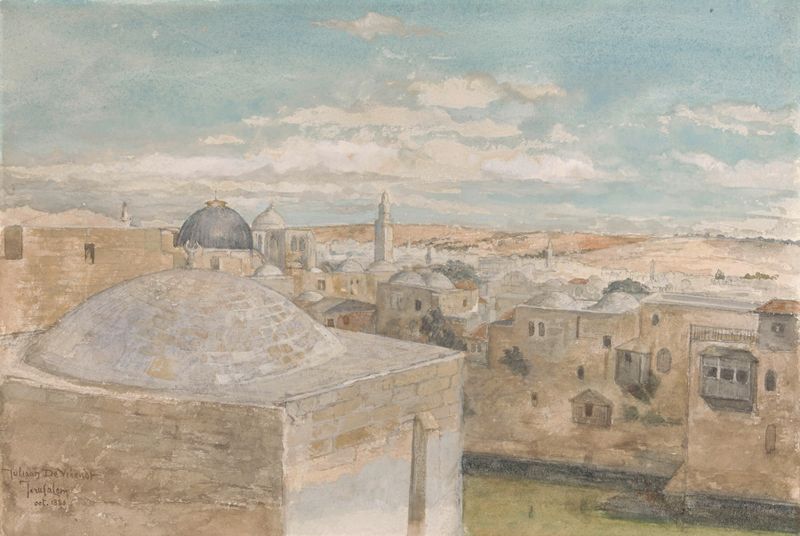
Could beauty survive in a century of chaos? This question lingers in the air as one gazes upon the striking composition that captures the essence of light transcending turmoil. Look to the center of the canvas, where the radiant glow of Jerusalem’s golden stones captures the eye, illuminated by a divine light that seems to emanate from within. The warm hues of ochre and soft beige contrast sharply with the cooler blues and grays of the sky, creating a visual tension that draws the viewer deeper into the scene. Each brushstroke reveals meticulous attention to detail, from the intricate architecture of the ancient buildings to the figures that traverse the foreground, their forms softened by the dappled light filtering through the clouds. Delve deeper and notice the juxtaposition of the serene landscape against the backdrop of a tumultuous history.
The distant silhouettes hint at both past conflicts and a hopeful future, embodying the duality of Jerusalem as a site of spiritual refuge and human strife. The play of shadows and light not only evokes a sense of peace but also serves as a reminder of the fragility of beauty amid chaos, urging the viewer to reflect on the resilience of the human spirit. In 1880, Juliaan De Vriendt was in the midst of his artistic development, having already gained recognition for his ability to portray profound landscapes. Painting in Belgium during a time of rapid change and modernization, the artist sought to encapsulate the timelessness of sacred places like Jerusalem, contrasting them with the social and political upheaval of his contemporary world.
This work reflects a moment of introspection, revealing both his personal quest for meaning and a broader commentary on the human condition.