Landscape — History & Facts
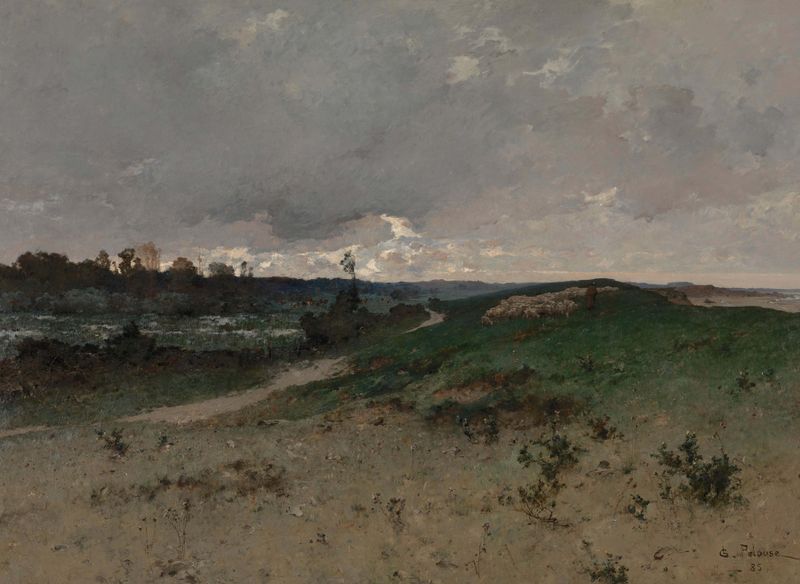
Memory weaves through time, inviting reflection in moments where the past seeps into the present and the familiar becomes a distant whisper. Focus on the vibrant hues that dominate the canvas, inviting your gaze to dance across lush greens and muted earth tones. Look to the horizon, where the delicate interplay of light and shadow creates a sense of depth, beckoning you into the landscape. Notice how Pelouse employs broad strokes and gentle gradients to evoke not just a scene, but a sensation—a memory suspended in the stillness of nature. The contrast between the vivid foreground and the softened background captures the tension between the fleeting and the eternal.
Hidden details emerge: a solitary figure in the distance, their presence both grounding and enigmatic, representing the shared journey of humanity within this expansive world. The tranquility exudes a longing, suggesting that while the scenery is serene, it carries the weight of untold stories and forgotten moments. Painted between 1860 and 1891, Pelouse was deeply engaged in the evolving Impressionist movement while navigating his own artistic voice. At this time, he was exploring the interplay of light and color, influenced by both his contemporaries and the changing landscapes of his rural surroundings.
His work encapsulates a moment of transition in art and life, where personal memory converges with the vastness of nature.