Landscape with Ruins — History & Facts
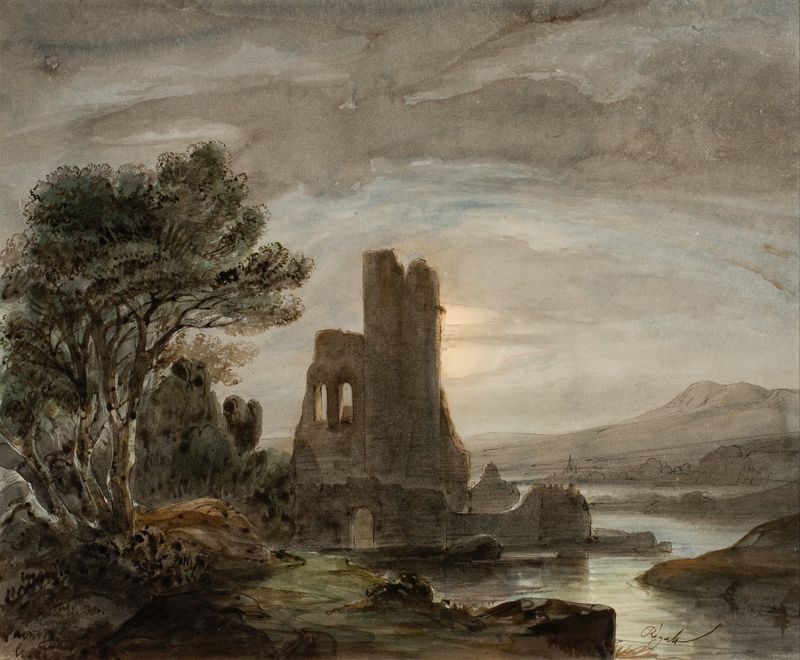
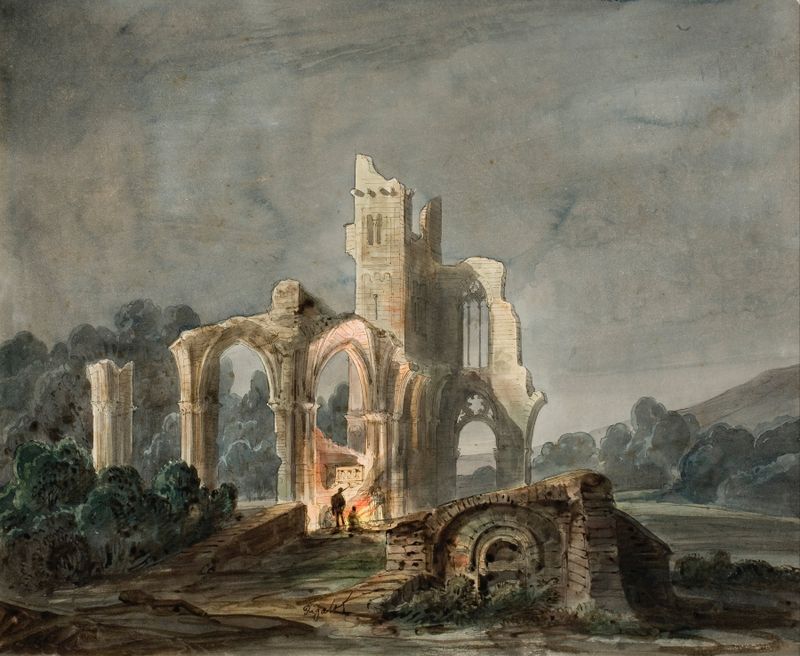
In stillness, it holds a story of beauty intertwined with chaos, inviting us to confront the aftermath of violence rooted deep within its landscape. The echoes of a past conflict linger, suggesting that nothing exists without the dark shadow of destruction. Look to the left at the skeletal remains of an ancient structure, its weathered stones jutting out against the horizon like jagged teeth. The artist’s palette evokes a muted earthiness, where ochres and grays blend seamlessly to evoke the decay of time.
Notice how a spectral light casts long shadows, revealing the contours of the terrain while simultaneously shrouding portions in an oppressive ambiguity. This contrast creates a tension between the tranquil landscape and the violence that seems to permeate the air. As you delve deeper, observe how the distant mountains carry a sense of watchful silence, standing sentinel over the ruins below. The juxtaposition of the serene sky against the crumbling architecture speaks to the resilience of nature amidst human folly.
Each brushstroke seems to whisper of stories untold — the lives that were once woven into the fabric of this land, now reduced to mere remnants. This dichotomy between beauty and desolation invites profound reflection on the enduring scars of conflict. Lluís Rigalt created this work during a time when the Romantic movement was gaining traction in Spain, navigating between the idealization of nature and the stark truths of human existence. Painted in the 19th century, his landscapes often reflect a fascination with both the pastoral and the ruins of civilization, as Spain grappled with its turbulent history and the shifting tides of artistic expression.
In this context, Landscape with Ruins emerges not just as a painting but as a poignant commentary on the intersection of art and violence.