
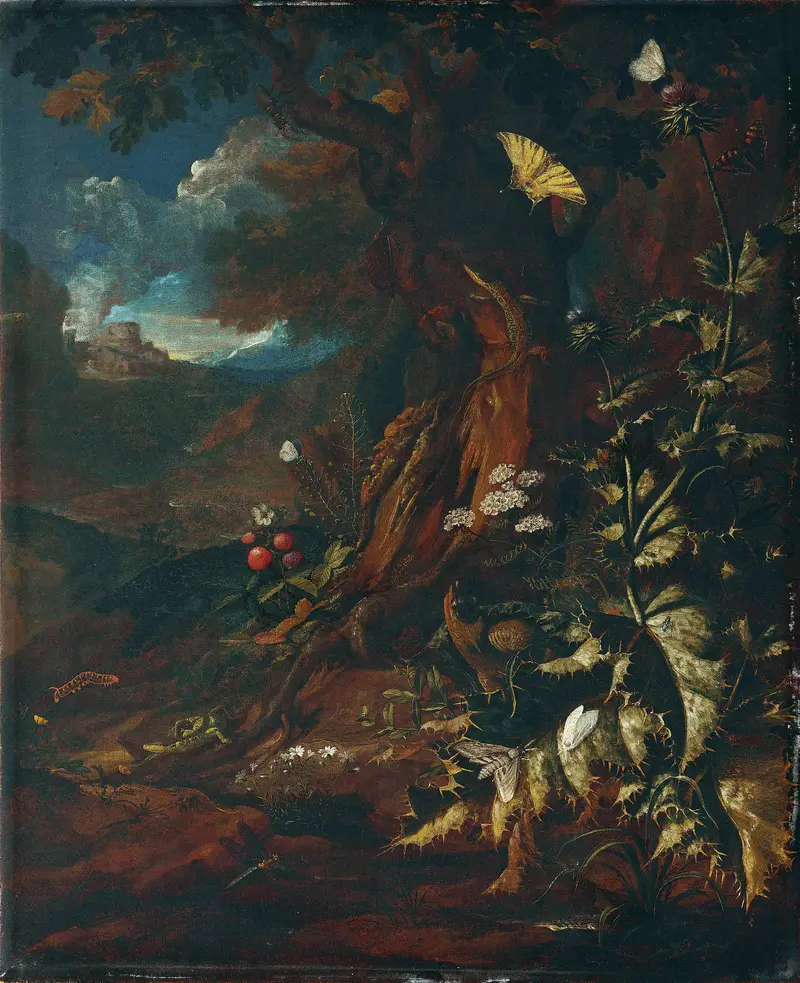
Landschaft mit Reptilien und Insekten — History & Facts
Focus first on the vibrant greenery at the center, where lush foliage bursts forth like a living tapestry. The artist’s meticulous brushwork captures the delicate veins of leaves, inviting you closer to appreciate the intricate details. Notice how the light dances across the canvas, casting shadows that give depth to the scene, while the reptiles and insects, rendered with exquisite precision, emerge from the undergrowth.
Their presence adds an unsettling tension to the otherwise idyllic landscape. Delve deeper, and you'll find contrasting elements that evoke both wonder and unease. The serene beauty of the landscape is disrupted by the lurking figures of the reptiles, symbolizing the perpetual cycle of life and death. The insects, tiny yet highly detailed, remind us of the fragility of existence amidst the grandeur of nature.
Each creature holds a story, a fleeting moment in the vast narrative of the natural world—an interplay of beauty and vulnerability that resonates on a profound level. Johann Adalbert Angermayer created this piece around 1730-740 during a period when natural history was gaining prominence in art. As he painted in Germany, the Enlightenment was fostering a growing interest in the observation of nature and its wonders. Angermayer, influenced by this shift, sought to capture not only the beauty of the natural world but also its intricate relationships and inherent risks, reflecting a deeper understanding of life's complexities.
More Artworks by Johann Adalbert Angermayer
More Landscape Art

Starry Night
Vincent van Gogh

View of Delft
Johannes Vermeer

Water Lilies
Claude Monet

The Grand Canal, Venice, looking north-west from the Ca' Corner to the Ca' Contarini degli Scrigni, with the campanile of Santa Maria della Carità
Canaletto

Windsor Castle
Canaletto

The Grand Canal looking North-East from the Palazzo Dolfin-Manin to the Rialto Bridge
Canaletto