Landweg over eenvoudige brug bij zware boom — History & Facts
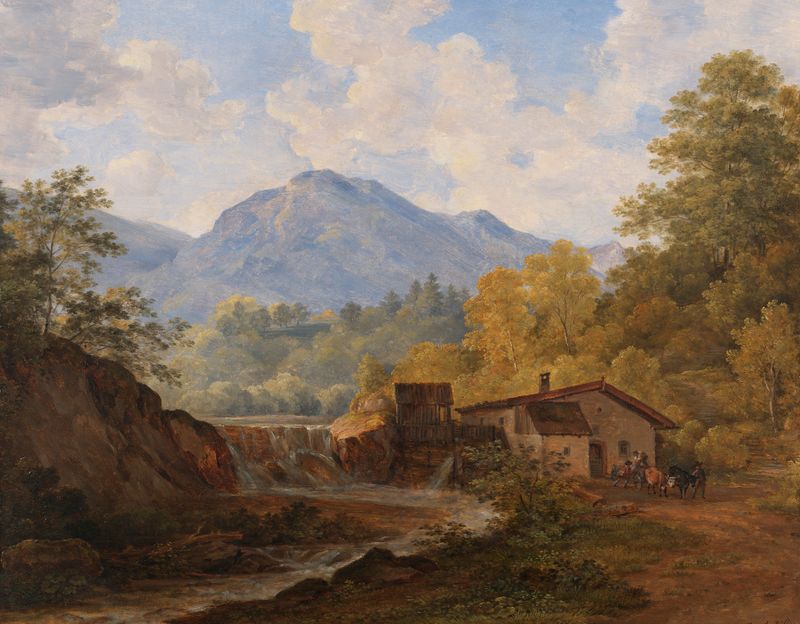
Who listens when art speaks of silence? In the tranquil embrace of nature, a simple bridge spans a gentle stream, inviting the viewer to pause and reflect on the world beyond its banks. Focus on the bridge, delicately rendered in the foreground, its modest structure contrasting with the towering, heavy tree that looms beside it. The artist employs a soft palette of greens and browns, with light filtering through the leaves, casting playful shadows on the ground. The composition leads the eye along the path of the bridge, drawing us into the serene yet powerful landscape that harmonizes nature's beauty with the promise of connection. Amidst the stillness, there lies an underlying tension between the weight of the tree and the fragility of the bridge.
This juxtaposition evokes feelings of hope and resilience, suggesting that even the most delicate connections can withstand the weight of time. Each brushstroke hints at stories waiting to unfold, capturing the essence of nature's tranquility while inviting introspection about life's journey. Cantius Dillis created this piece between 1790 and 1799, during a time when the art world was embracing Romanticism, emphasizing the beauty and emotional power of nature. As he painted, Dillis was influenced by the serene landscapes of his surroundings, reflecting a period where artists sought to express their inner thoughts through the simplicity of rural life.
This artwork stands as a testament to his vision, where nature serves as both a silent observer and a catalyst for hope.