
Les bois de Sèvres — History & Facts
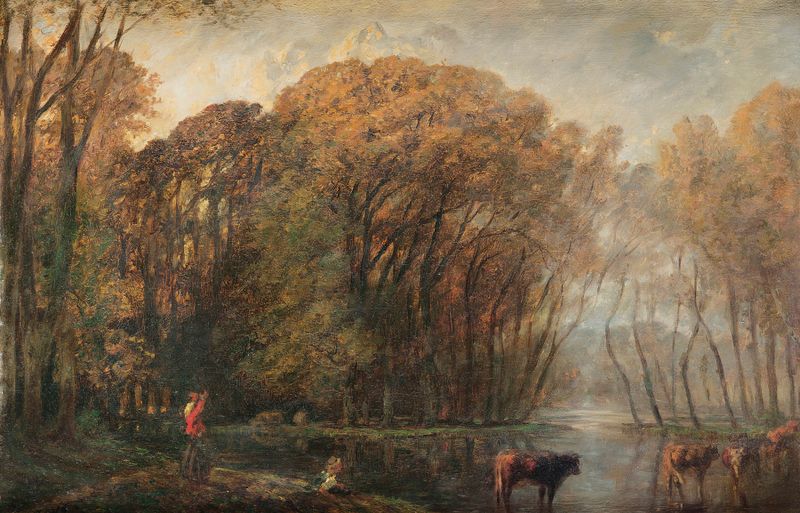
In the stillness of nature, beneath the great canopy of trees, an unsettling whisper lingers in the air, hinting at both beauty and dread. The wild journey of the mind through the woods can evoke both wonder and a lurking fear, a duality that resonates deeply within the heart of every observer. Look to the left, where the twisted trunks of ancient trees emerge from an enveloping mist, their gnarled forms almost alive as they beckon the viewer deeper into the shadows. The varied greens of the foliage create a lush tapestry, contrasting sharply with the ghostly pallor of the fog that seeps through the underbrush.
Every brushstroke is carefully placed, giving a sense of movement while also anchoring the viewer in a moment of poised anticipation, as if something unseen is watching just beyond the veil. In this landscape, contrasts abound: the vibrant life of the forest stands in stark opposition to the oppressive silence that pervades the scene. The interplay of light and shadow conjures a sense of unease, as if the very woods hold secrets of past wanderers, their fates woven into the very fabric of the earth. The absence of human presence intensifies the feeling of isolation, suggesting that nature itself can be both sanctuary and prison, eliciting a primal fear of the unknown. The work was created by Paul Huet during a period of profound change in 19th-century France, where Romanticism was taking root, emphasizing emotion and the sublime in nature.
As he explored the depths of the forests near Sèvres, his own life was marked by both personal struggles and an evolving artistic landscape. This painting stands as a testament to the tension between the beauty of the natural world and the fear that comes from confronting its depths.
More Artworks by Paul Huet
Browse all →
An Abbey by a Wooded Lake at Twilight
Paul Huet

Woodland Stream
Paul Huet
The Laïta in high tide, Brittany
Paul Huet

Sur la route de Nice
Paul Huet
Soleil couchant
Paul Huet

A Wild Beech in Full Leaf
Paul Huet

Les Roches noirs, bij Villers
Paul Huet

Cannes
Paul Huet

Mountain View at Oisans (Isère)
Paul Huet

Mountains of Auvergne
Paul Huet





