
Les Tuileries et le Pont Royal, en 1843 P2077 Musée Carnavalet — History & Facts
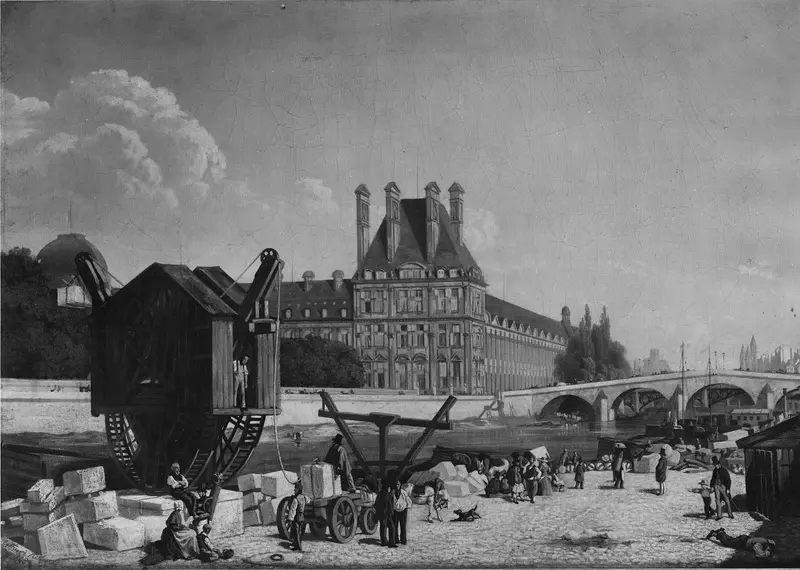
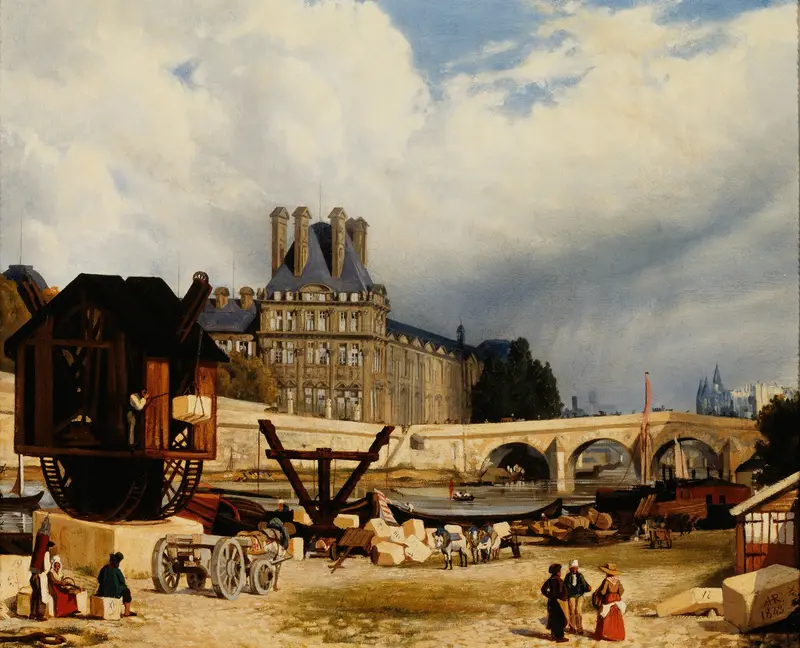
What first seizes the eye in Les Tuileries et le Pont Royal, en 1843 is not the grandeur of the palace or the sweep of the Seine, but the monumental wooden wheel dominating the foreground—a feat of engineering as much as a symbol of the city’s restless transformation. The painter, Arthur Henry Roberts, draws us into a Paris caught mid-breath: the riverbank is alive with labor, stone blocks marked and ready, carts waiting, and workers intent on their tasks. The light, crisp and clear, picks out the pale stone of the Tuileries and the bridge, but lingers longest on the machinery and the people—reminding us that the city’s monuments are built by many hands.
The clouds, heavy and rolling, lend drama to the sky and push our gaze back down to the busy ground. This is Paris in 1843, a city in flux, where the old royal palace stands watch over the ceaseless work of modernization. Paintings like this were often made for a public fascinated by progress, eager to see their city’s transformation recorded in paint as faithfully as in newsprint. The presence of the Pont Royal, with its elegant arches, anchors the scene in the city’s history, while the construction equipment and bustling figures point toward its future.
Collected today by Paris Musées, this work preserves not only the look of a place, but the pulse of an era—inviting us to linger over every figure and every stone, and to imagine the city’s story unfolding from this very bank.
More Artworks by Arthur Henry Roberts
More Landscape Art

The Starry Night
Vincent van Gogh

View of Delft
Johannes Vermeer

Water Lilies
Claude Monet

The Grand Canal, Venice, looking north-west from the Ca' Corner to the Ca' Contarini degli Scrigni, with the campanile of Santa Maria della Carità
Canaletto

Windsor Castle
Canaletto

The Grand Canal looking North-East from the Palazzo Dolfin-Manin to the Rialto Bridge
Canaletto