The Port aux Pierres on the Quai d'Orsay — History & Facts
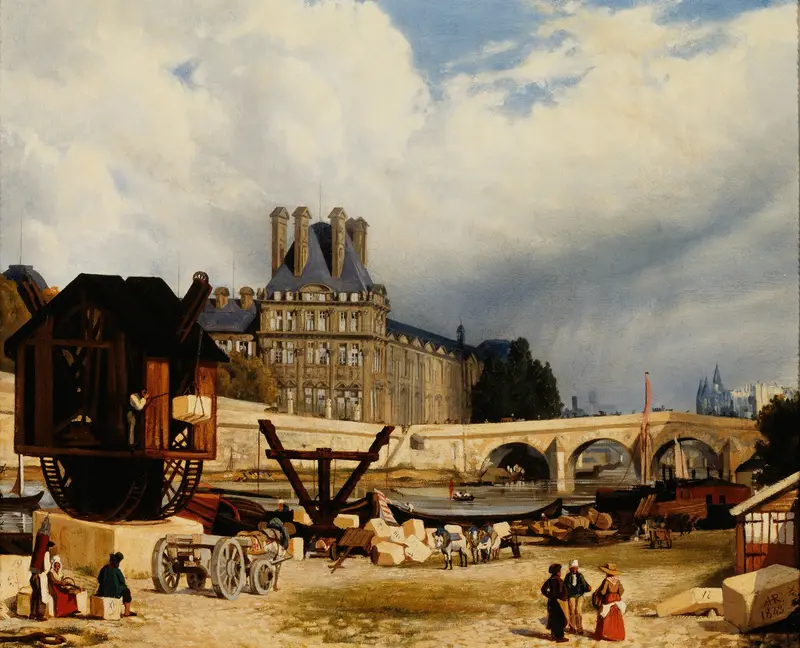
What first draws the eye in The Port aux Pierres on the Quai d'Orsay is the imposing wooden crane, a marvel of industrial ingenuity, looming over a riverside scene thrumming with activity. The artist, Arthur Henry Roberts, orchestrates a careful choreography: blocks of stone are hoisted and carted, figures pause in conversation or labor, while the grand, almost theatrical backdrop of Parisian architecture anchors the scene in a very specific time and place. The light, clear and deliberate, falls across the stone and the faces, picking out the textures of work and the quiet drama of daily life.
Every detail, from the rigging on the docked boats to the arch of the distant bridge, invites the viewer to linger and piece together the rhythms of a city in motion. Painted in 1848, this work captures a world on the cusp of transformation. Mid-nineteenth-century Paris was a city of grand projects and ceaseless construction, its quays and boulevards reshaped by commerce and ambition. Paintings like this—often commissioned by city officials, engineers, or private patrons—served as both records and celebrations of urban progress.
While history has kept few traces of Arthur Henry Roberts and his individual career, this canvas now in the collection of the Museum of Fine Arts, Boston, stands as a testament to the era’s fascination with industry and the everyday. Look again at the figures: each one is a thread in the tapestry of a city remaking itself, stone by stone.